
Disclosure: As an Amazon Associate I earn from qualifying purchases at no extra cost to you.
Hatching fertilized eggs from our own flock and raising chicks without buying commercial day-olds is one of the deepest satisfactions of off-grid homesteading in Southern Hokkaido.
It is also brutally unforgiving when hardware fails or management blind spots stack up.
This spring, two equipment failures hit back-to-back in freezing April weather:
our 3-year-old incubator/brooder temperature probe stuck at a false reading of 42.4°C (108.3°F)—shutting off the heater and
killing ~30 eggs just 3 days before hatch—and a cold water splash shattered a garage heat bulb.
I improvised a clever workaround (forcing the thermostat above 42.4°C while
cutting a pass-through doorway into an unheated “cool escape room”) that kept 40–50 chicks thriving through week four.
Yet right after I relaxed and moved those month-old pullets outdoors, roughly 30 birds died—leaving 19 survivors (just under 10 pullets).
Here is the unfiltered crisis log so you never repeat my mistakes.
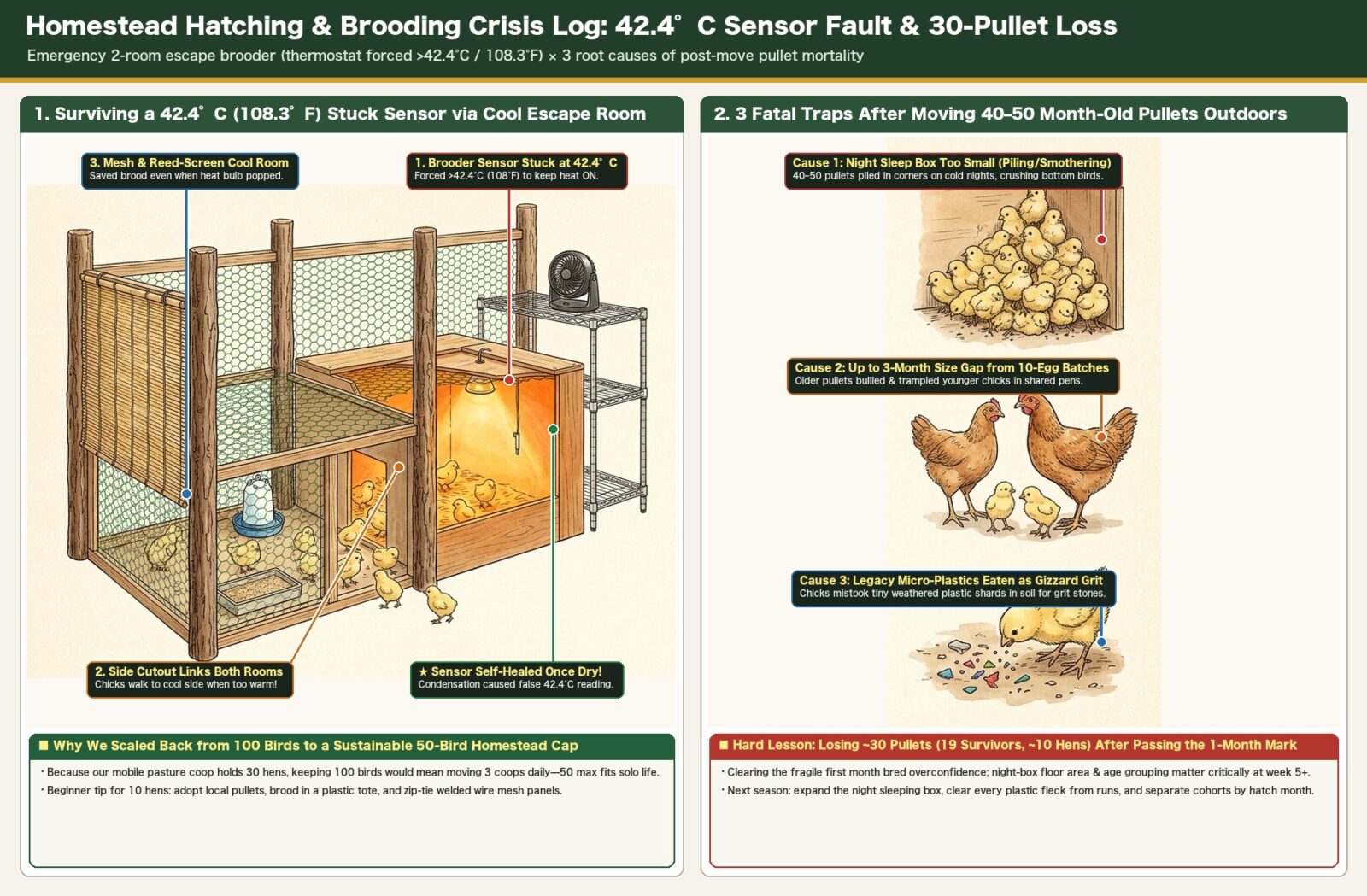
- Beating a Stuck 42.4°C (108.3°F) Sensor: Cranking the target setpoint above 42.4°C forced the heater back ON, while linking an unheated wire-mesh “cool escape room” let chicks self-regulate away from overheating (and the condensed NTC sensor healed itself once dry!).
- Why ~30 Month-Old Pullets Died Outdoors: Three compounding traps—(1) a night sleep box too tight for 40–50 piling juveniles (smothering/crushing), (2) up to a 3-month size gap from hatching 10 eggs at a time, and (3) weathered micro-plastic flecks eaten as gizzard grit.
- Right-Sizing from 100 Birds to 50 Max: Because our 30-hen mobile pasture coop handles 30 layers cleanly, capping our homestead flock around 50 birds keeps solo management sustainable.
1. Surviving a Stuck 42.4°C (108.3°F) Probe & Shattered Bulb via the “Two-Room Escape Brooder”
In April, when Hokkaido nights still hover near freezing, disaster struck twice.
First, I woke up to find our 3-year-old incubator/brooder cold—its digital temperature sensor had glitched upward,
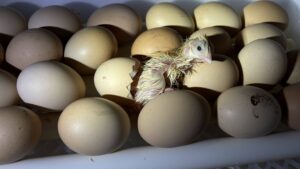
convincing the controller it was overheating and killing a batch of ~30 eggs just 72 hours shy of pipping.
Days later, while refilling chick waterers in the garage brooder lit by two bare incandescent bulbs, a stray splash of cold water hit hot glass and shattered a bulb on the spot.
Rather than scrapping the 3-year-old unit or waiting days for replacement parts while chicks shivered,
I watched the faulty readout closely: the broken sensor was frozen steady right around 42.4°C (108.3°F).
Because a thermostat simply compares current reading vs. target setpoint,
dialing the target temperature higher than 42.4°C immediately tricked the relay into turning the heater back ON!
 けっち
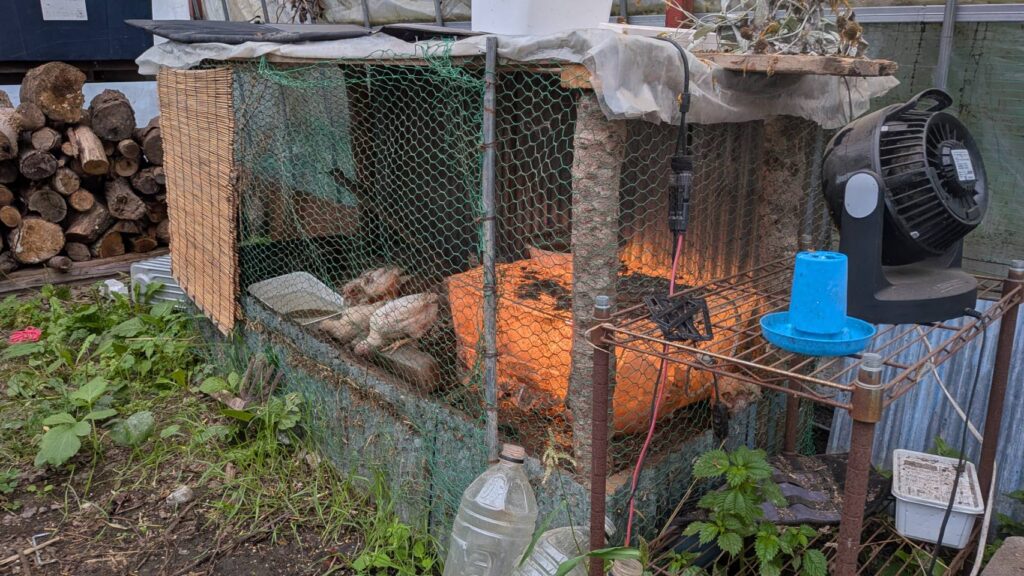
Of course, forcing a heater continuously ON inside a closed box would cook chicks alive—so I cut a doorway in the side wall and
attached an unheated wire-mesh “cool escape room” right next door so every chick could walk in and out on its own two feet.
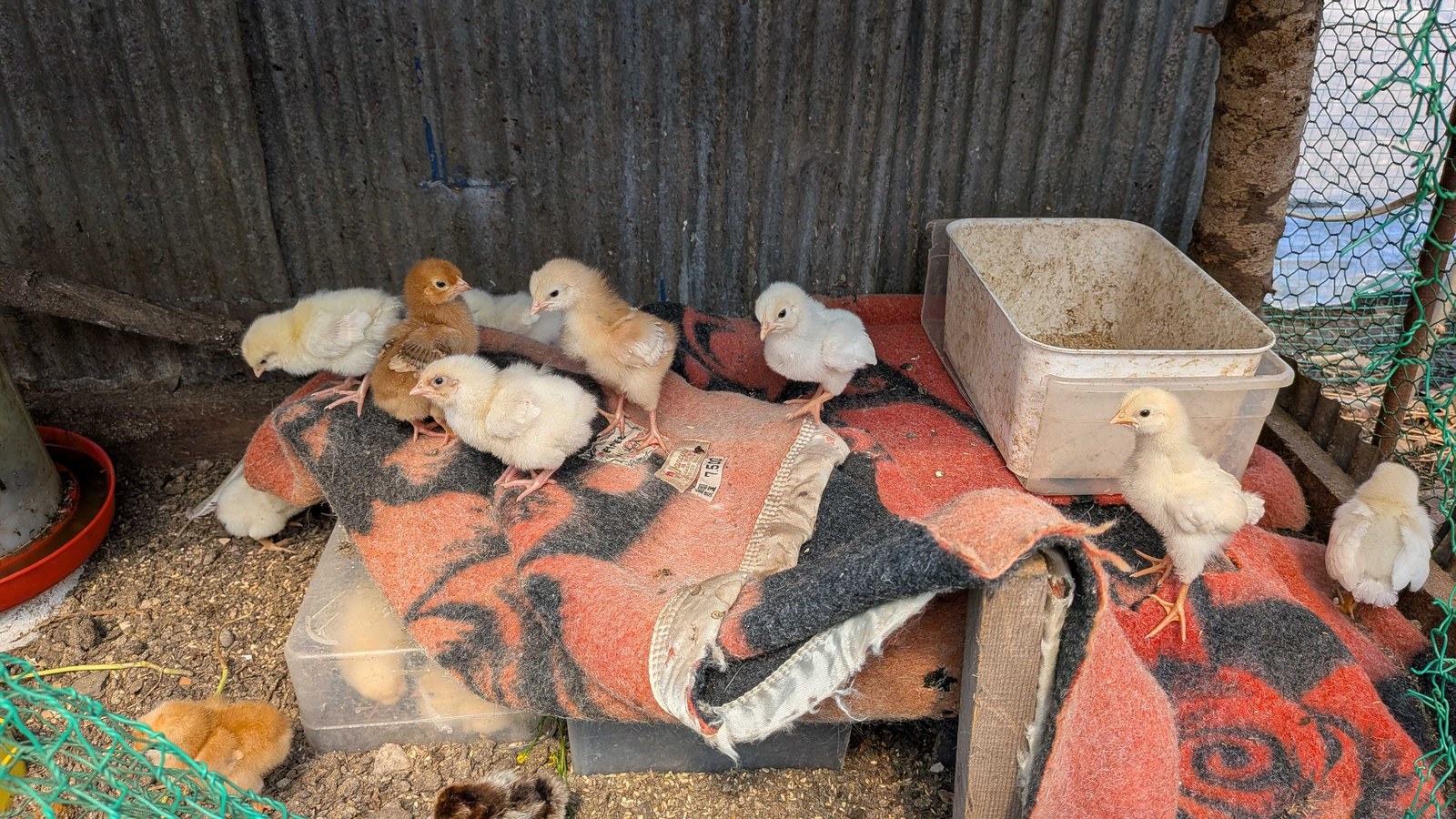
That two-room escape brooder worked like magic for a full month: chilled chicks ducked into the warm orange chamber to nap,
then trotted out into the unheated mesh run whenever they warmed up.
Even better, weeks later that “broken” 42.4°C sensor spontaneously healed itself!
Standard incubator probes use negative-temperature-coefficient (NTC) thermistors: when high hatching humidity condenses inside the sensor sleeve,
moisture bridges the leads, drops electrical resistance, and reports a phantom spike around 42°C+.
Once thoroughly dried out, accurate readings returned—saving the machine for next spring.
2. Hard Truth: How I Lost ~30 Juveniles After Passing the 1-Month Milestone
Clearing the fragile first four weeks made me overconfident.
When I moved roughly 40 to 50 feathered month-old chicks out to the rear grow-out pen,
losses snowballed until only 19 birds survived (slightly rooster-heavy, leaving barely 10 future hens).
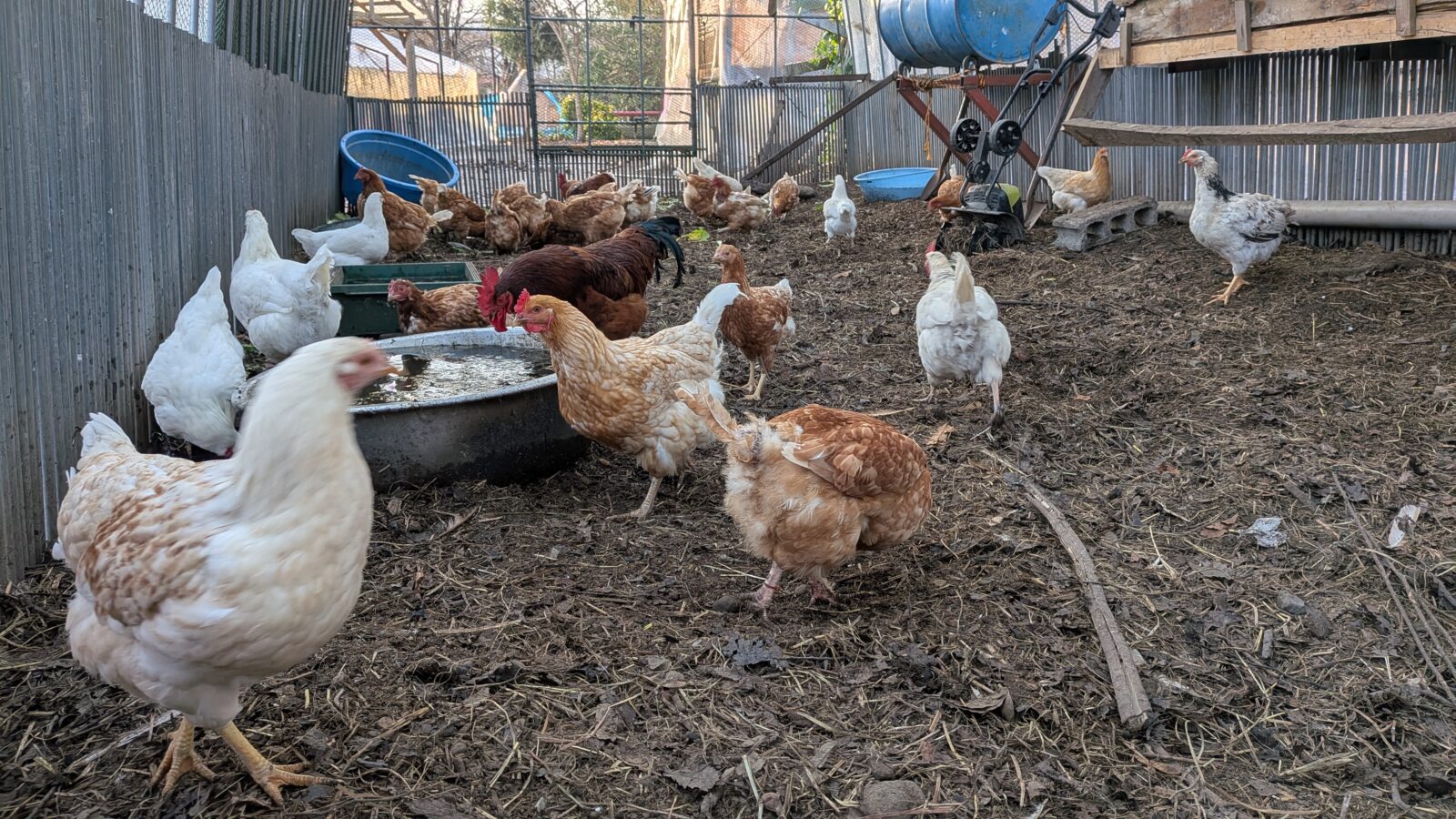
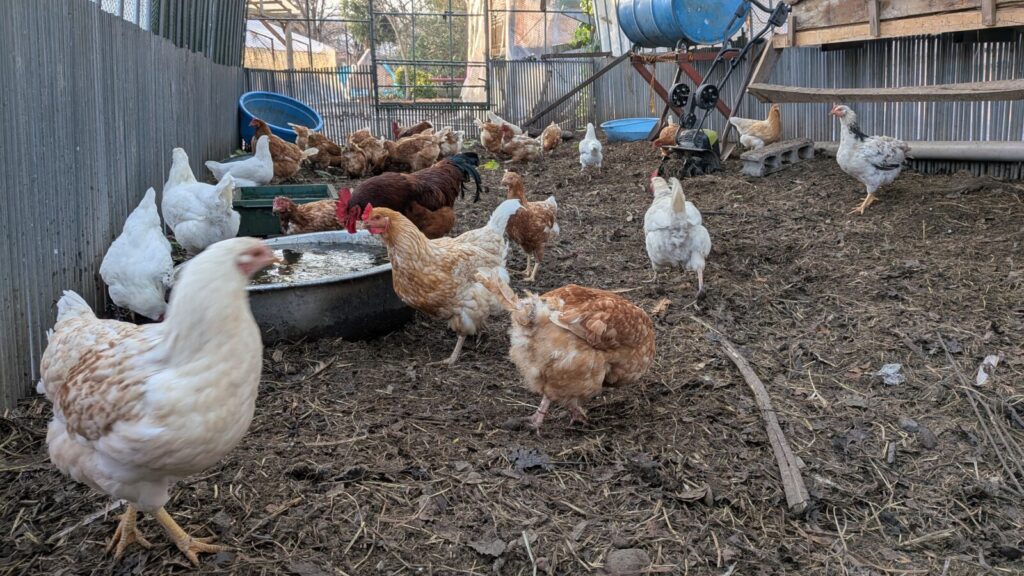
Looking squarely at the evidence in the pen, three factors collided:
- Night Sleeping Box Too Small (Corner Piling & Smothering): As documented in Japanese livestock research on juvenile poultry piling, newly relocated pullets frightened by unfamiliar night sounds or chill instinctively crowd into tight corners in a multi-layer pyramid. In a sleep box sized too small for 40–50 growing birds, smaller chicks on the bottom layer were crushed or suffocated overnight.
- Up to a 3-Month Size Gap from Sequential 10-Egg Hatches: Collecting ~10 fertilized eggs a day meant I loaded batches sequentially rather than all at once—creating up to a 3-month age and body-mass gap between the oldest and youngest juveniles sharing the same sleeping box.
- Legacy Soil Micro-Plastics Mistaken for Gizzard Grit: Toothless birds swallow small pebbles to grind whole grain inside the muscular gizzard. Tiny weathered plastic shards buried in the old backyard soil looked just like colorful grit stones to curious juveniles, risking crop/gizzard impaction.
Before next spring’s hatch, expanding the night sleeping box footprint and
raking/screening plastic flecks out of the juvenile run are top priorities—while I still wrestle with how to separate sequential age cohorts without doubling daily chore pens.
3. Why I Scaled My Target Back from 100 Birds to 50 (+ Best Starter Path for 10 Hens)
Early on, I talked about scaling up to 100 birds.
Practical field math changed my mind: our pasture mobile coop holds 30 adult hens comfortably.
Jumping to 100 birds would mean building and moving two more full-sized tractors every day.
Capping the homestead around 50 birds maximum (slowly replacing older hens each year) fits a solo off-grid life far better.
If you are a beginner planning your first 10 backyard hens, skip my hard mode and start with the right-hand column below:
| Stage | My Route (Intermediate / Hard Mode) | Recommended Beginner Route (~10 Hens) |
|---|---|---|
| 1. Getting Starter Birds | Fertile eggs + digital incubator (vulnerable to sensor glitches & sequential age gaps). | Adopt started pullets or adult hens locally via farm classifieds/neighbors—skip the fragile hatch stage first. |
| 2. Brooder Setup | Custom wooden garage heat box + side escape pen. | 1 deep hardware-store plastic storage tote + caged heat bulb (plenty of room for 10 chicks). |
| 3. First Predator-Safe Coop | Driven steel hoop pipes + welded square tubing. | Simple pipe/wood frame wrapped in 1×2 m welded wire mesh panels fastened with heavy UV zip-ties—cheap, fast, and fox-proof. |
4. Frequently Asked Questions
A. Internal condensation inside the NTC probe sleeve is the #1 culprit.
In an emergency, raise the setpoint above the stuck reading to restore heat, immediately open a pass-through into an unheated escape space so
chicks can walk away from excessive heat, and dry the probe thoroughly afterward.
A. Nighttime corner piling in a cramped sleeping box—especially when different hatch dates mix big 10-week birds with smaller 4-week chicks.
Give them wide floor space, rounded corners, and clean grit free of soil plastic debris.
Field-Tested Gear Used in This Log
Disclosure: As an Amazon Associate I earn from qualifying purchases at no extra cost to you.
- Digital Automatic-Turning Egg Incubator — Forced-air digital temperature control with automatic egg turner for 21-day natural flock replacement. Field note: Lets us hatch fertilized eggs from our hardy survivor hens at zero chick cost. Check US specs on Amazon.com (paid link)
Disclosure: As an Amazon Associate I earn from qualifying purchases at no extra cost to you.
- Poultry Brooder Ceramic Heat Bulb (60W/100W) & Digital Thermostat Controller — Caged radiant brooder heater paired with probe thermostat; always leave an unheated cool-escape zone!. Field note: Critical lesson: sensors can stick—always give chicks a cool escape room. Check US specs on Amazon.com (paid link)
Disclosure: As an Amazon Associate I earn from qualifying purchases at no extra cost to you.
- Heavy-Duty Lidded Polypropylene Tote / Nest Box Tub — Washable deep-wall utility tote repurposed as draft-free raised nest boxes and rodent-proof grain bins. Field note: Easy to sanitize, light to mount off the coop floor, and impervious to moisture. Check US specs on Amazon.com (paid link)
If sharing our toughest brooding losses helps protect your own flock this spring, you can support the homestead on Buy Me a Coffee.



Comments