
Disclosure: As an Amazon Associate I earn from qualifying purchases at no extra cost to you.
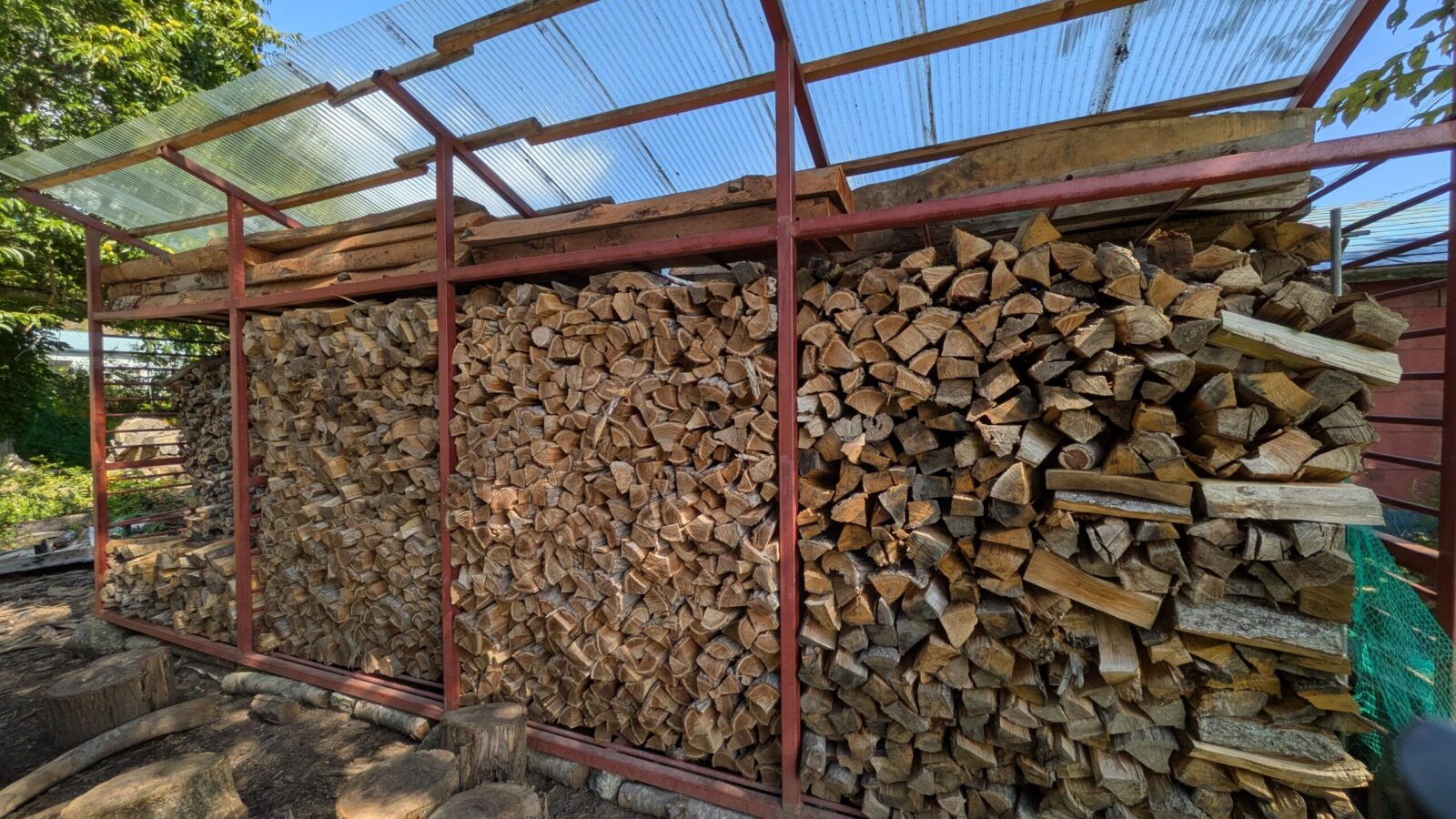
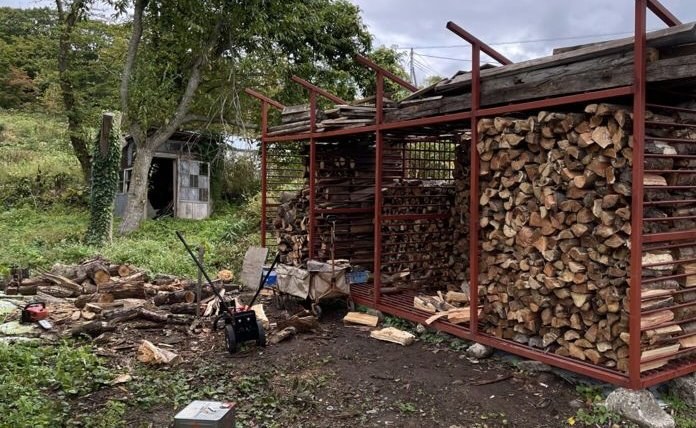
When I welded together our 6-meter, 4-row “Fortress Firewood Rack” holding roughly 18 cubic meters (~5 full cords) of 30 cm (12 in) splits,
I confidently wrote that since an average Hokkaido home burns 5 to 10 m³ per winter, our rack held two full winters of fuel with room to spare.
Then we actually lived through winter.
By spring thaw, nearly the entire 18 m³ (~5 cords) rack was empty in a single season.
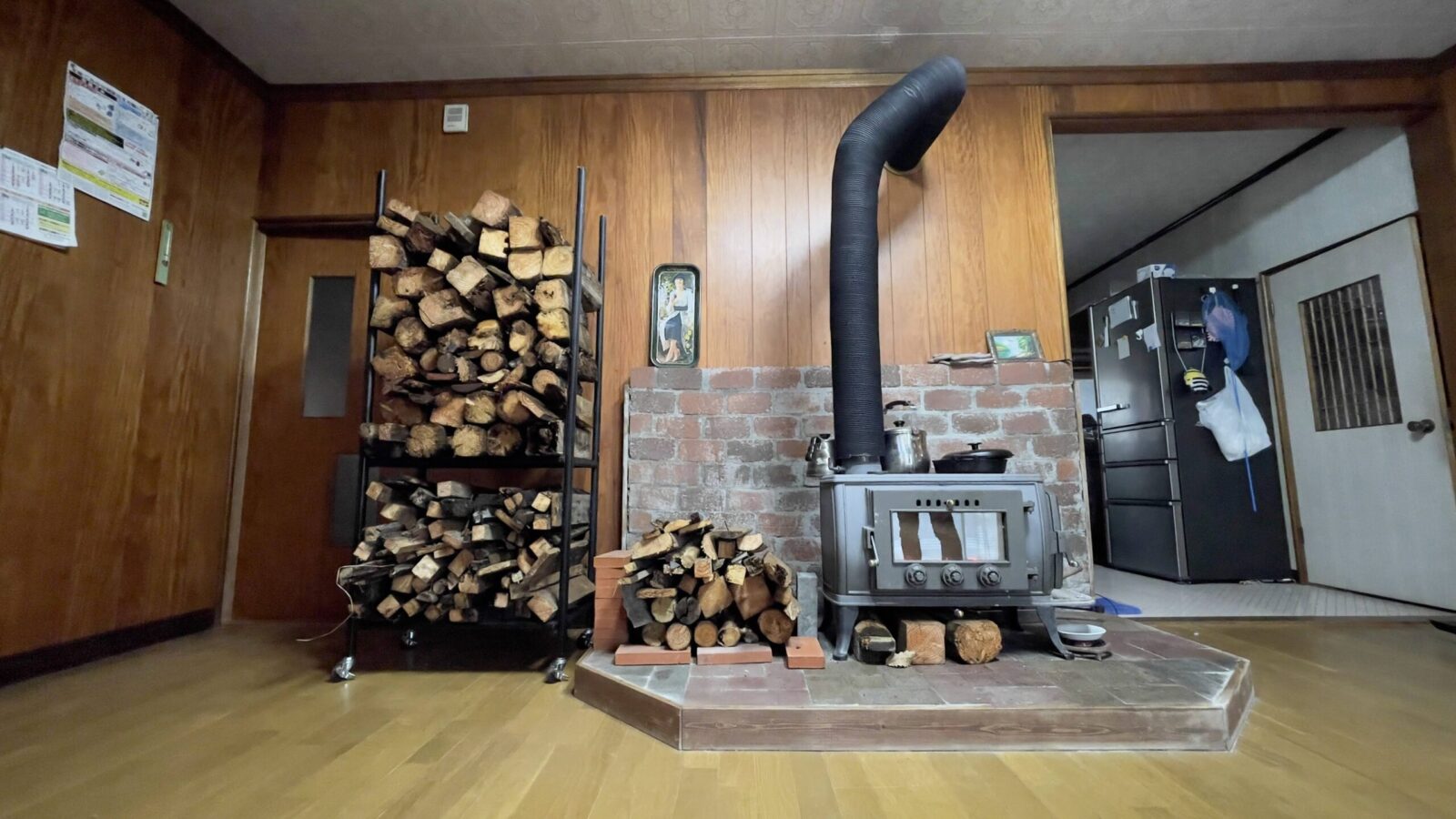
Heating a large uninsulated footprint across two wood stoves with lightweight Japanese chestnut (Castanea crenata) burned far faster than dense oak—yet burning hot and
wide-open kept our chimney so clean it needed zero mid-winter sweeping.
Here is the honest 1-year post-mortem: how I source 100% of our logs for $0, why leaving bucked rounds unsplit is haunting me right now,
and how we sort clean splits vs. gnarly knots across two stoves with zero waste.
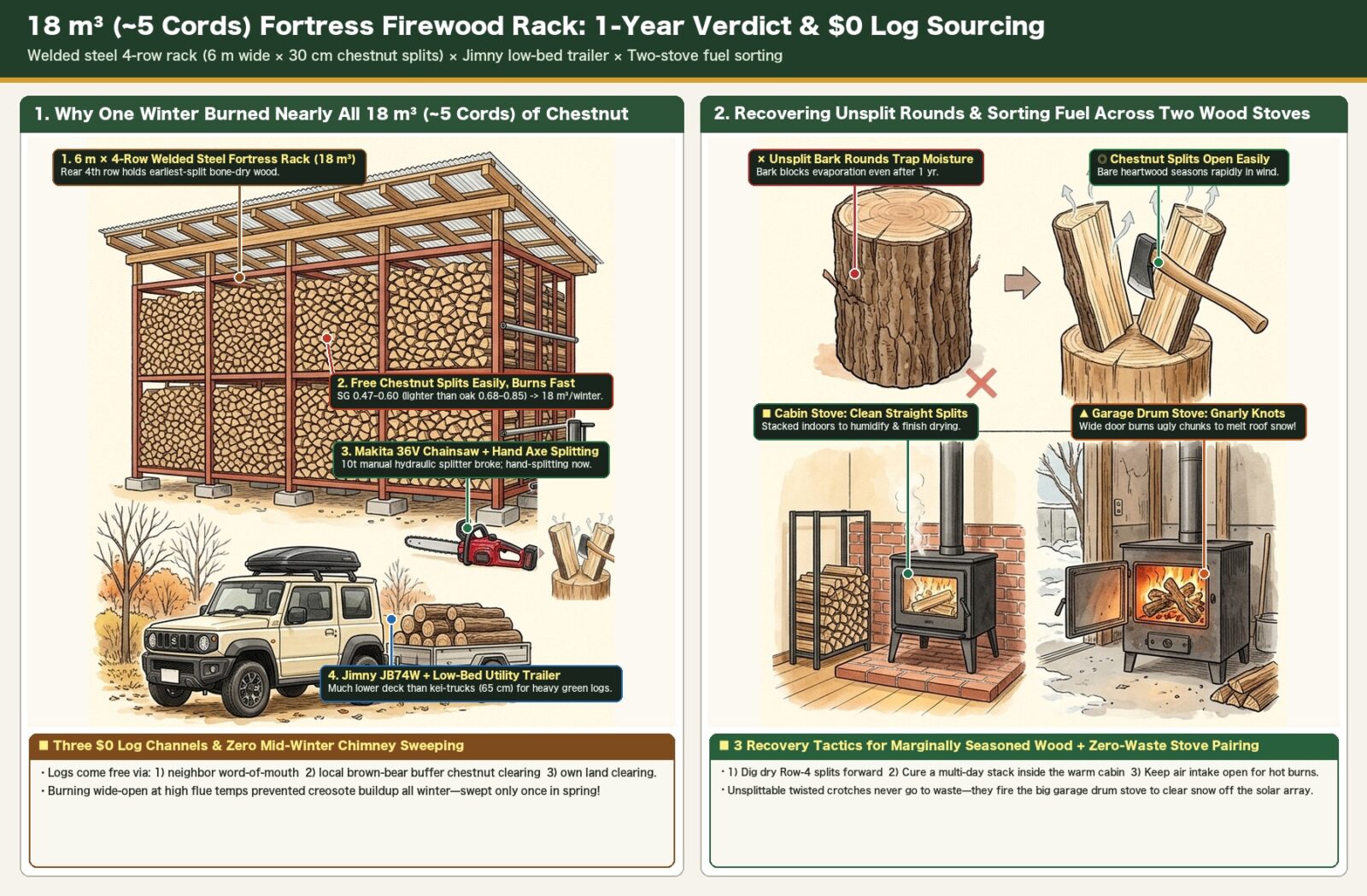
- Chestnut Splits Like Butter, Burns Fast: Ring-porous chestnut (air-dry specific gravity 0.47–0.60) pops apart effortlessly under a hand axe, but holds ~25–30% less BTU density per cord than oak (0.68–0.85)—consuming ~18 m³ across one winter.
- Three $0 Log Channels + Late-Autumn Felling: Neighbor word-of-mouth, municipal Hokkaido brown-bear buffer clearing, and homestead land clearing supply 100% free timber—felled after leaf-drop and hauled before deep snow closes forest tracks.
- Unsplit Rounds Don’t Dry + Two-Stove Sorting: Bark traps moisture even after a year; straight splits heat & humidify the main cabin, while twisted knots fire the big garage drum stove to melt snow off our solar array.
1. Why 18 m³ (~5 Cords) Vanished in One Winter—And Why the Flue Stayed Spotless
Checking wood-science tables alongside Honma Stove’s fuel guide explains the math immediately: hardwood doesn’t automatically mean oak-level burn times.
Because our free harvest last year was predominantly wild chestnut, each armful carried much lower mass than dense white oak or sawtooth oak.
| Species Group | Air-Dry Specific Gravity | Burn Behavior | Hand-Axe Splitting Feel |
|---|---|---|---|
| Japanese Chestnut (Last Winter’s Main Fuel) | 0.47 – 0.60 (Light hardwood) | Ignites fast & burns hot, shorter coal life (pops sparks if damp) -> ~18 m³ / winter. | Ring-porous straight grain—pops cleanly in half with one swing. |
| Oak / Kunugi (Premium Dense Hardwood) | 0.68 – 0.85 (Heavy hardwood) | Slow ignition, long-lasting overnight coals (~10 m³ would suffice). | Dense interlocked fibers; thick rounds are tough manual labor. |
| Cedar / Pine / Scrap Lumber (Softwood) | 0.38 – 0.53 (Light softwood) | Flashes up to high temp rapidly, burns out fast. | Splits effortlessly; ideal for kindling & short garage snow-melt burns. |
One huge silver lining came out of burning chestnut briskly without choking the air intake: flue gas stayed hot enough to prevent sticky creosote condensation.
We burned straight through from autumn to spring without needing a single mid-winter chimney sweep, doing just one clean annual sweep once heating season ended in spring.
2. Three $0 Log Channels & Why Late Autumn (Leaf-Drop to First Deep Snow) Is Prime Time
Buying 5 full cords of delivered kiln-dried hardwood in Japan would cost thousands of dollars—so we pay $0 for timber across three local channels:
- Rural Neighbor Network: Word-of-mouth calls whenever neighbors clear boundary trees (“Come buck it up if you want the firewood!”).
- Community Brown-Bear Buffer Clearing: In Hokkaido, wild chestnut trees near settlements attract Ezo brown bears in autumn. Joining local bear-buffer brush and tree clearing turns a community safety chore into truckloads of free chestnut logs.
- Own Land Reclamation & Demolition Salvage: Felling trees while expanding pasture plus clean untreated salvage timber.
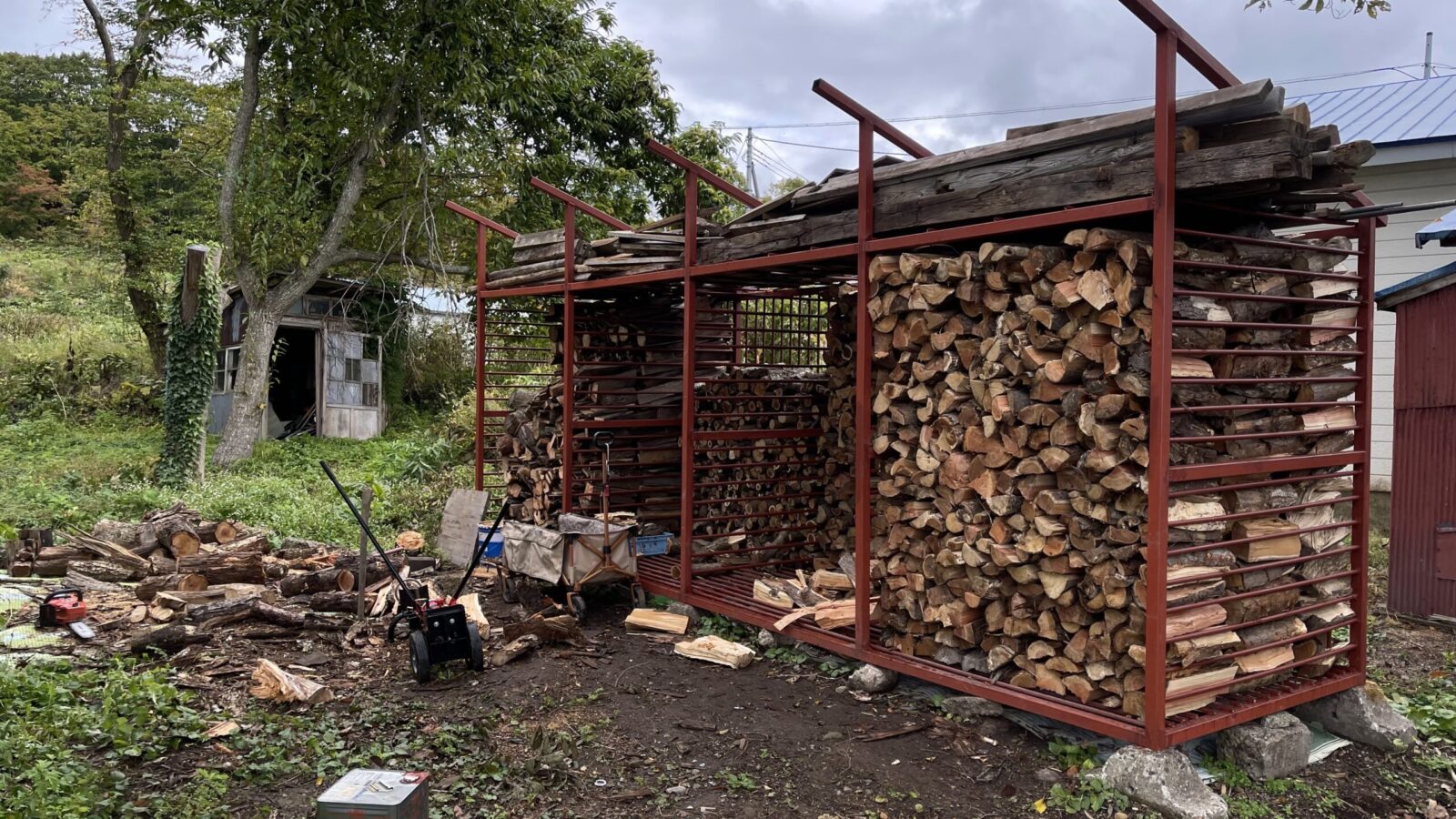
For next year’s supply, I am heading out to fell and buck 10+ standing trees strictly inside the narrow window after all deciduous leaves drop and before deep winter snow locks in.
Dormant leafless trees pull less sap water from their roots, visibility in the woods opens up, and—most practically—unplowed mountain tracks become impassable once heavy snow hits.
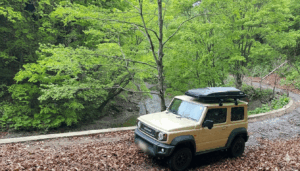
To haul heavy green rounds home behind my Suzuki Jimny Sierra (JB74W),
I pull a low-bed utility trailer whose deck sits far lower than a Japanese kei-truck bed (~65 cm / 25.6 in), saving my lower back on every lift.
3. Hand-Axe Splitting & Our Broken 10-Ton Manual Hydraulic Splitter
Right now, 100% of our firewood is split with a hand axe.
Ring-porous chestnut makes hand-splitting genuinely satisfying—aim through the pith and straight-grained rounds crack cleanly in half.
I previously owned a lever-pumped ~10-ton manual hydraulic log splitter,
which worked great with minimal arm strength until its hydraulic seal/valve assembly failed under heavy volume.
Eventually I want to salvage its steel beam and weld on an electric motor pump,
though that motorized conversion remains strictly an [Unstarted Design Concept] for a future shop project.
4. This Season’s Honest Headache: Unsplit Rounds + Our Two-Stove Sorting System
Heading into winter #2, here is my biggest mistake from last year: a pile of bucked rounds I left sitting unsplit for a year is still damp inside.
Tree bark evolved specifically to seal moisture in; until you split a round and expose bare heartwood, radial evaporation crawls.
To bridge this seasoning gap safely, I am combining three recovery tactics:
- Dig Out Row #4 First: Pull forward the bone-dry splits stacked earliest in the back row of the 4-row rack while newly split rounds finish curing.
- Indoor “Humidifier Stack” Rapid Curing: Wood-heated cabins get desert-dry in winter. Brushing bark debris/bugs off outdoors and stacking several days’ worth of slightly damp splits inside the warm room (well clear of stove fire-safety clearances) humidifies our indoor air while driving off remaining moisture in days.
- Mix with Dry Scrap & Burn Hot: Pair marginal splits with bone-dry dimensional lumber scraps and keep primary air open so flue temps never smolder.

 けっち
Hand-splitting always leaves twisted crotches and knotty chunks that refuse to split cleanly—instead of fighting them with wedges,
we toss every ugly chunk straight into the wide-mouth garage stove whenever it’s time to melt snow off the solar panels!
5. Frequently Asked Questions
A. Yes—especially if you split by hand, because its ring-porous grain pops apart effortlessly.
Just account for its lighter specific gravity (0.47–0.60 vs. oak’s 0.68–0.85) by stacking roughly 30–40% more volume for winter, and season it well so it doesn’t pop embers.
A. Rarely.
Intact bark acts as a vapor barrier; even 12 months later, unsplit hardwood rounds retain high core moisture.
Split rounds as soon as possible after bucking to expose bare wood grain to the wind.
Field-Tested Gear Used in This Log
Disclosure: As an Amazon Associate I earn from qualifying purchases at no extra cost to you.
- Makita 36V (18V X2 LXT) Brushless Cordless Chainsaw (MUC353D / XCU03) — 14-inch bar powered by dual 18V LXT batteries; zero gas mixing, zero carburettor gum-up, charged via free solar. Field note: Fells 10+ bear-buffer hardwoods every autumn on 100% solar electricity. Check US specs on Amazon.com (paid link)
Disclosure: As an Amazon Associate I earn from qualifying purchases at no extra cost to you.
- Sheet-Steel / Cast-Iron Wood Stove & Forged Splitting Hatchet — Simple non-catalytic wood stove (zero electronics to fail) + hand splitting axe for 18 m³ (5 cords) winter fuel. Field note: Two-stove sorting: bone-dry seasoned hardwood indoors, marginal logs in the garage drum stove. Check US specs on Amazon.com (paid link)
Disclosure: As an Amazon Associate I earn from qualifying purchases at no extra cost to you.
- LVYUAN 200W Monocrystalline Solar Panel / 440W Bifacial Array Equivalent — Weatherproof ETFE monocrystalline solar module for off-grid 48V MPPT charging & mobile rig auxiliary power. Field note: Paired with my 6x 440W south-facing greenhouse-garage solar bridge. Check US specs on Amazon.com (paid link)
If these $0 firewood sourcing and two-stove sorting notes help keep your own woodpile ahead of winter, you can buy Seta & the flock a coffee here.





Comments