
Disclosure: As an Amazon Associate I earn from qualifying purchases at no extra cost to you.
When I first wired up my DIY solar setup in Southern Hokkaido—six 440W monocrystalline panels (2.64 kW total), two 48V 100Ah LiFePO4 server-rack/floor batteries (10.24 kWh), and a 5,000W hybrid inverter tied straight into our cabin’s main breaker panel—I ended that build log assuming I would buy several more batteries as soon as I saved up the cash.
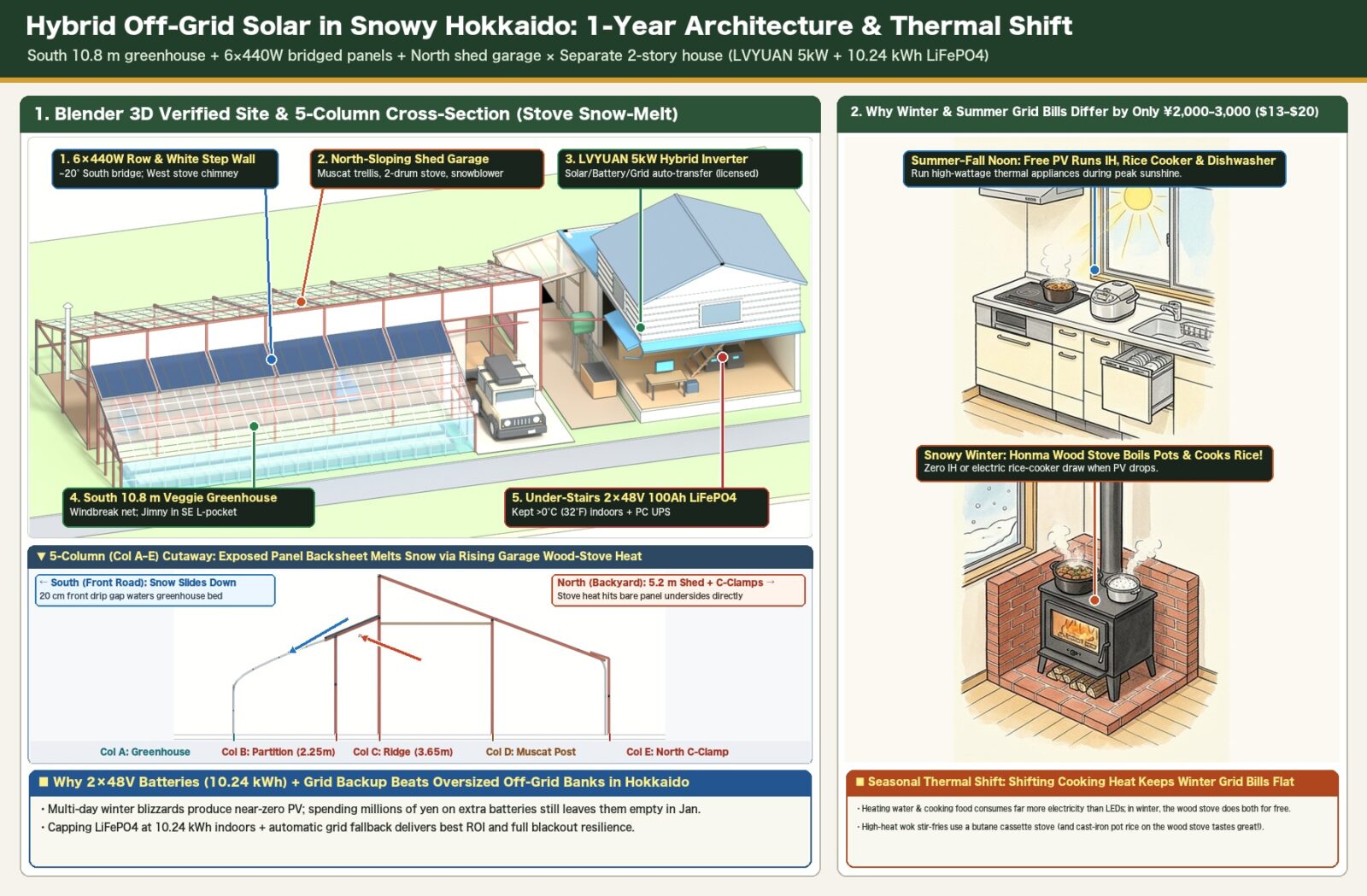
One full Hokkaido winter later, my verdict flipped completely: in snowy northern latitudes, capping storage at two 48V 100Ah batteries (10.24 kWh) and keeping utility grid fallback as a “hybrid off-grid” system beats spending tens of thousands of dollars chasing 100% off-grid purity. Better yet, because we run induction cooktops, rice cookers, and the dishwasher on free midday sunshine in summer and shift almost all cooking heat onto our wood stove in winter, our summer and winter utility bills differ by only ¥2,000–3,000 (~$13–$20 USD) per month.
- Why We Didn’t Expand Past 10.24 kWh: Multi-day winter blizzards bury panels and block sun; even a massive $15,000 battery bank drains flat in January. Two 48V 100Ah batteries + automatic grid transfer deliver maximum return on investment and full blackout resilience.
- Seasonal Thermal Shift ($13–$20 Winter Bill Delta): Summer midday PV powers high-wattage induction & dishwashing for free; winter wood-stove pot cooking eliminates heavy electric heating loads when solar drops.
- Two Real-World Engineering Caveats: Watch out for the 10–20 ms inverter transfer blink (protect desktop PCs with a portable power station / UPS) and never charge LiFePO4 below 0°C (32°F)—keep batteries indoors under the stairs and add winter insulation.
 けっち
Surviving a real Hokkaido winter taught me a simple engineering truth: extra batteries can’t store sunshine that isn’t there—and when your wood stove runs 24/7, your kitchen barely needs electricity anyway.
1. Why Hybrid Solar (2× 48V Batteries + Grid Fallback) Beats Pure Off-Grid in Northern Snowbelts

Because our 5kW hybrid inverter feeds the cabin’s main distribution board (performed under licensed electrical work rules), every wall outlet—from the fridge and washing machine to my Makita 18V 3-unit dual-port charging station (one genuine DC18RD + two third-party dual chargers)—runs directly off solar and battery power whenever the sun shines.

Originally, keeping our utility grid hookup was just a budget compromise because I couldn’t afford six batteries up front. After 12 months of live telemetry, however, stopping at two 48V 100Ah units proved to be the sweet spot. From spring through autumn, solar covers daytime appliances and charges all 14 surviving active Makita 18V compatible batteries (chosen after burning through 23 packs) for free; during multi-day winter snowstorms, the inverter seamlessly falls back to grid power without forcing us to run noisy gas generators—while still guaranteeing instant backup power if an earthquake knocks down regional power lines.
2. The “Seasonal Thermal Shift”: Why Winter & Summer Grid Bills Differ by Only $13–$20
Most folks assume that once winter clouds and snow slash solar output, our winter electric bill must skyrocket. In reality, our winter utility bill is only ¥2,000 to ¥3,000 (~$13–$20 USD) higher than midsummer. Why? Because LED lights and laptops draw very little power—resistive heat appliances (induction ranges, electric rice cookers, water heating) swallow the lion’s share of household kilowatt-hours, and our cooking fuel naturally flips with the seasons.
| Season | Solar PV Output | Cooking & Thermal Appliance Strategy |
|---|---|---|
| Spring – Autumn | Abundant free midday solar surplus | Run high-draw IH induction cooktops, electric rice cooker, and dishwasher during peak sunshine hours; gently reheat dinner at night. |
| Snowy Winter (-3 to -8°C) | Low PV during snow & overcast weeks | Cabin wood stove runs all day—boil water, simmer stews, and cook pot rice right on the stove top (using a butane cassette burner only for high-heat wok stir-fries). |
People often romanticize wood-stove pot rice and ask if it tastes way better than an electric rice cooker. Honestly? It tastes pretty much the same—you just have to watch the water ratio a little closer. What matters is that shifting thermal cooking loads onto free firewood keeps winter electricity consumption minimal even when the panels are resting.
3. Step-Wall Solar Snow Shedding & Year-2 Shine Muscat Green Curtain
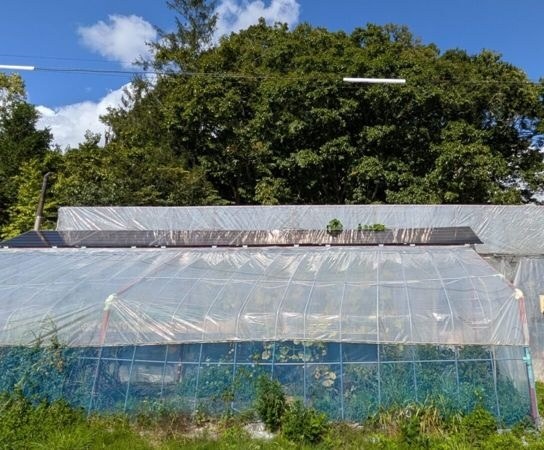
Each 440W solar panel weighs roughly 20 kg (44 lbs)—manageable enough to haul up onto the framing solo. Rather than mounting panels flat on a house roof where wet Hokkaido snow packs solid, I engineered a height step between our lower south-facing vegetable greenhouse and our taller north-sloping storage garage, bridging the six 440W panels at an angle across that step with bare panel backsheets exposed inside the ceiling.

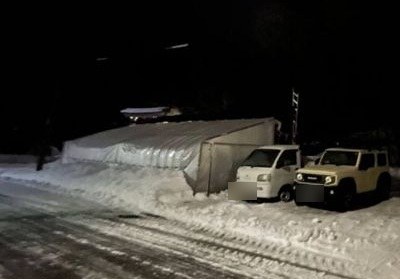
Whenever heavy snow blankets the array, firing up the big two-drum wood stove inside the garage sends warm air straight up against the bare undersides of the panels. A thin melt film forms against the glass, the entire snow slab slides cleanly off into the front lane, and one pass with the snowblower clears the pile—zero sketchy ladder climbing required.
Inside that dirt-floored garage section, the Shine Muscat grapevine I planted straight into the native soil is now in its second year. It hasn’t fruited yet (maybe next summer if we’re lucky), but its lateral cordons have stretched wide across the framing—promising a lush natural “green curtain” next summer to shade the greenhouse when midday heat spikes.
4. Two Real-World Warnings: The 10–20 ms Transfer Blink & 0°C LiFePO4 Charging Rule
- The 10–20 ms Grid/Solar Transfer Blink Shutting Down Desktop PCs: When the hybrid inverter switches between battery/PV mode and utility grid bypass, there is a physical 10–20 millisecond transfer gap (explicitly noted in LVYUAN’s engineering specs as non-zero-transfer). Battery-less desktop PCs can hard-reboot and smart remote-controlled LED ceiling lights may reset during that blink. Stick to physical wall switches for lighting, and place a portable power station with EPS/UPS pass-through (or dedicated UPS) ahead of desktop computers.
- Never Charge LiFePO4 Batteries Below 0°C (32°F): While lithium iron phosphate cells can safely discharge in sub-freezing temperatures, pushing charging current into LiFePO4 cells below 0°C (32°F) causes metallic lithium plating on the graphite anode—permanently damaging capacity and safety. Keeping our two 48V packs indoors under the cabin stairs prevented freezing throughout year one, and this winter I am adding rigid foam insulation around that under-stair bay for extra thermal margin.

5. Frequently Asked Questions
A. Because multi-day coastal snowstorms deliver near-zero solar harvest in December and January, even five or six 48V batteries will eventually hit 0% unless backed up by fuel generators. Two 48V 100Ah batteries (10.24 kWh) paired with utility fallback and winter wood-stove cooking gives 90% of the freedom at a fraction of the cost.
A. Honestly, I still don’t know half the obscure sub-menus—once the core 48V LiFePO4 charge/cutoff voltages and solar-priority mode are set properly and wired safely by a licensed electrician, the unit switches hands-off all year.
Field-Tested Gear Used in This Log
Disclosure: As an Amazon Associate I earn from qualifying purchases at no extra cost to you.
- LVYUAN 200W Monocrystalline Solar Panel / 440W Bifacial Array Equivalent — Weatherproof ETFE monocrystalline solar module for off-grid 48V MPPT charging & mobile rig auxiliary power. Field note: Paired with my 6x 440W south-facing greenhouse-garage solar bridge. Check US specs on Amazon.com (paid link)
Disclosure: As an Amazon Associate I earn from qualifying purchases at no extra cost to you.
- LVYUAN 5kW 48V Hybrid Solar Inverter (Built-In MPPT Charge Controller) — 48V LiFePO4 battery input + PV MPPT + utility grid fallback; skips massive winter battery over-sizing. Field note: Core of my hybrid strategy: 100% solar induction cooking in summer, wood-stove heating in winter. Check US specs on Amazon.com (paid link)
Disclosure: As an Amazon Associate I earn from qualifying purchases at no extra cost to you.
- EcoFlow RIVER 2 Pro Portable LiFePO4 Power Station (768Wh / 800W) — LiFePO4 3,000+ cycle chemistry, <30ms EPS/UPS switchover backup for PC & router during inverter transfer. Field note: Absorbs the 10–20ms grid/solar transfer blink on my hybrid off-grid setup. Check US specs on Amazon.com (paid link)
If this 1-year hybrid off-grid telemetry helps you avoid over-spending on batteries, feel free to support the homestead on Buy Me a Coffee.



Comments