
*This article contains affiliate links (such as Amazon Associates). All tools and gear introduced here are based on my firsthand testing and daily use on my homestead in Southern Hokkaido.
On my homestead in Southern Hokkaido, where winter temperatures range strictly between -3°C to -8°C (18-27°F), I live alongside roughly 50 free-range chickens and my beloved Jomon Shiba, Seta (female). In the past, a standard vinyl-coated wire tether corroded and snapped in under a year. Seta bolted toward the road dragging 1.5 meters of broken wire, leaving only her collar behind—an incident that completely drained the color from my face.
Reflecting on that risk, I replaced all ropes and leads with tough, visually inspectable alternatives, while rethinking how to handle an energetic, powerful Jomon Shiba both indoors and out. Below, I share my firsthand experiences regarding their wild fox-like appearance, high physical ability, the cat-like way they play indoors, and why I deliberately choose a collar over a standard harness for practical homestead safety.
Here are the 4 essential items I personally purchased and continue to use daily for managing Seta on my homestead in Southern Hokkaido. Use the links on the right to jump straight to the comparison widget.
| Gear / Material | Homestead Application & Selection Reason | Price & Stock |
|---|---|---|
| Pecute Retractable Leash (50kg capacity, 8m / 10m) | For mountain walks and outings. Uses durable nylon tape instead of wire to reduce snapping risks. | See US Gear Box below |
| Climbing Rope (8.5mm – 10mm diameter, UIAA certified) | Used for her ~7m home tether line. Replaced coated wire with a rope showing visible wear. | See US Gear Box below |
| Mountaineering Locking Carabiner (20kN+ rating) | Screw-lock hardware securely connecting the 2.5m overhead base line and 7m lead. | See US Gear Box below |
| O’TOM Tick Twister (Set of 2 sizes) | Specialized hooks for cleanly removing ticks picked up in Hokkaido grass without leaving mouthparts. | See US Gear Box below |
 けっち

It might differ slightly from standard pet gear, but after experiencing dangerous wire failures, I separated what absolutely must not break from what should act as a safety release, ultimately leading me to these four items.
What is a Jomon Shiba? Differences from Standard Shibas
To put it bluntly, the Jomon Shiba is not a separate, newly created dog breed, but rather a native lineage retaining primitive skeletal traits close to ancient Japanese dogs. Preserved through groups like the Jomon Shiba Research Center (JSRC), they are bred to match the skeletal ideal of dogs excavated from Jomon period ruins.
Research organization websites explicitly note that the term ‘Jomon Shiba’ is for research purposes rather than a commercial puppy sales brand. They feature distinct differences in facial structure, dentition, and musculature compared to standard companion Shibas found in pet shops.
Shallow Stops (Fox Face) and Sharp Facial Features
Many owners wonder if their slim, fox-faced dog is a Jomon Shiba. The ultimate way to tell is by looking at the shallowness of the ‘stop’—the indentation where the forehead meets the bridge of the nose.
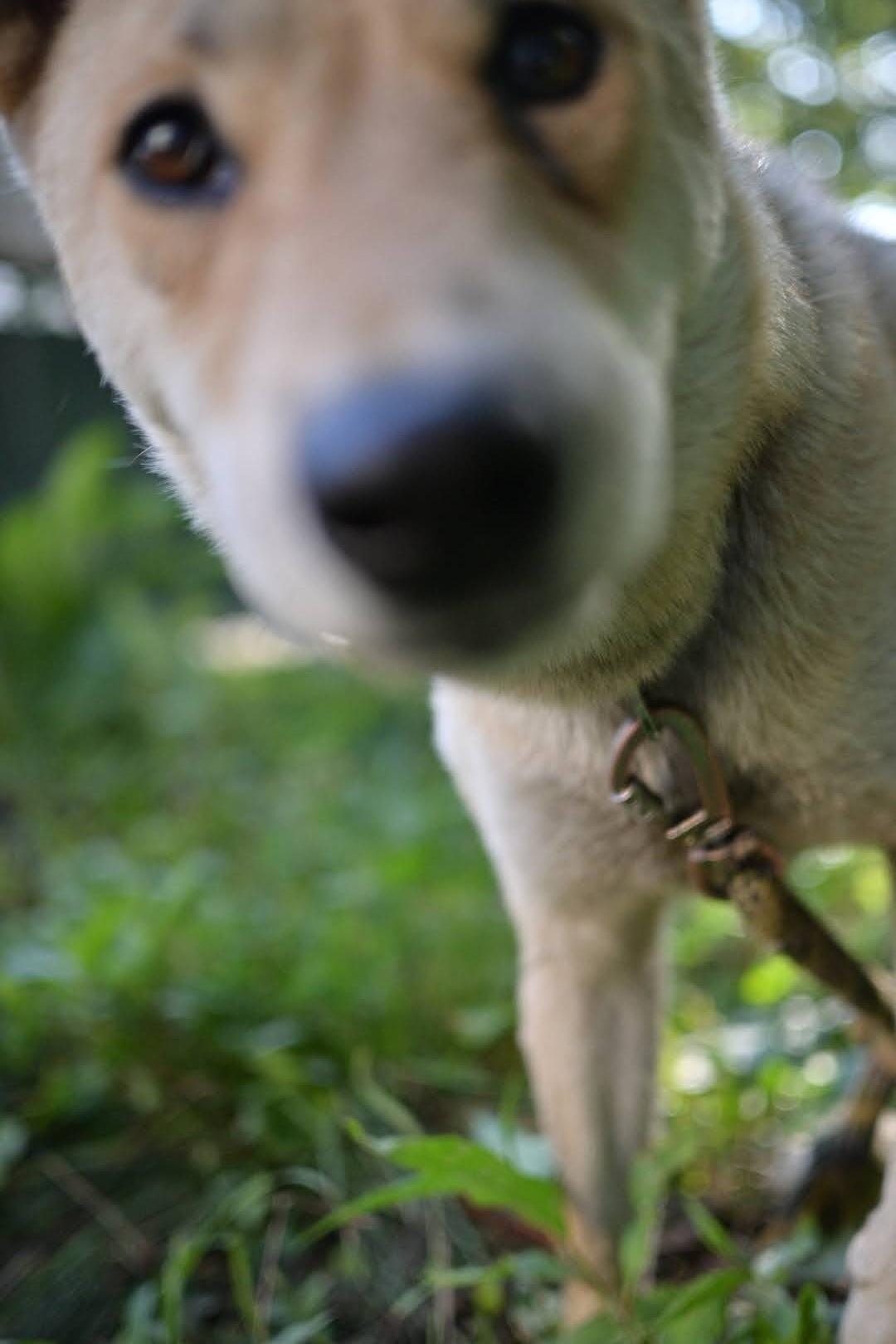
Most modern pet Shibas have rounder, amiable ‘tanuki faces’ with a distinct step between the forehead and nose. In contrast, Jomon Shibas feature a straight, continuous line from forehead to nose tip, resulting in a sharp, wolf- or fox-like appearance.
Thick Muzzles and Strong Jaws with 42 Permanent Teeth
While their faces look slender, their muzzles are robust and solidly built. Dogs naturally have a total of 42 permanent teeth, but modern miniaturized pet Shibas often suffer from missing teeth due to jaw crowding.
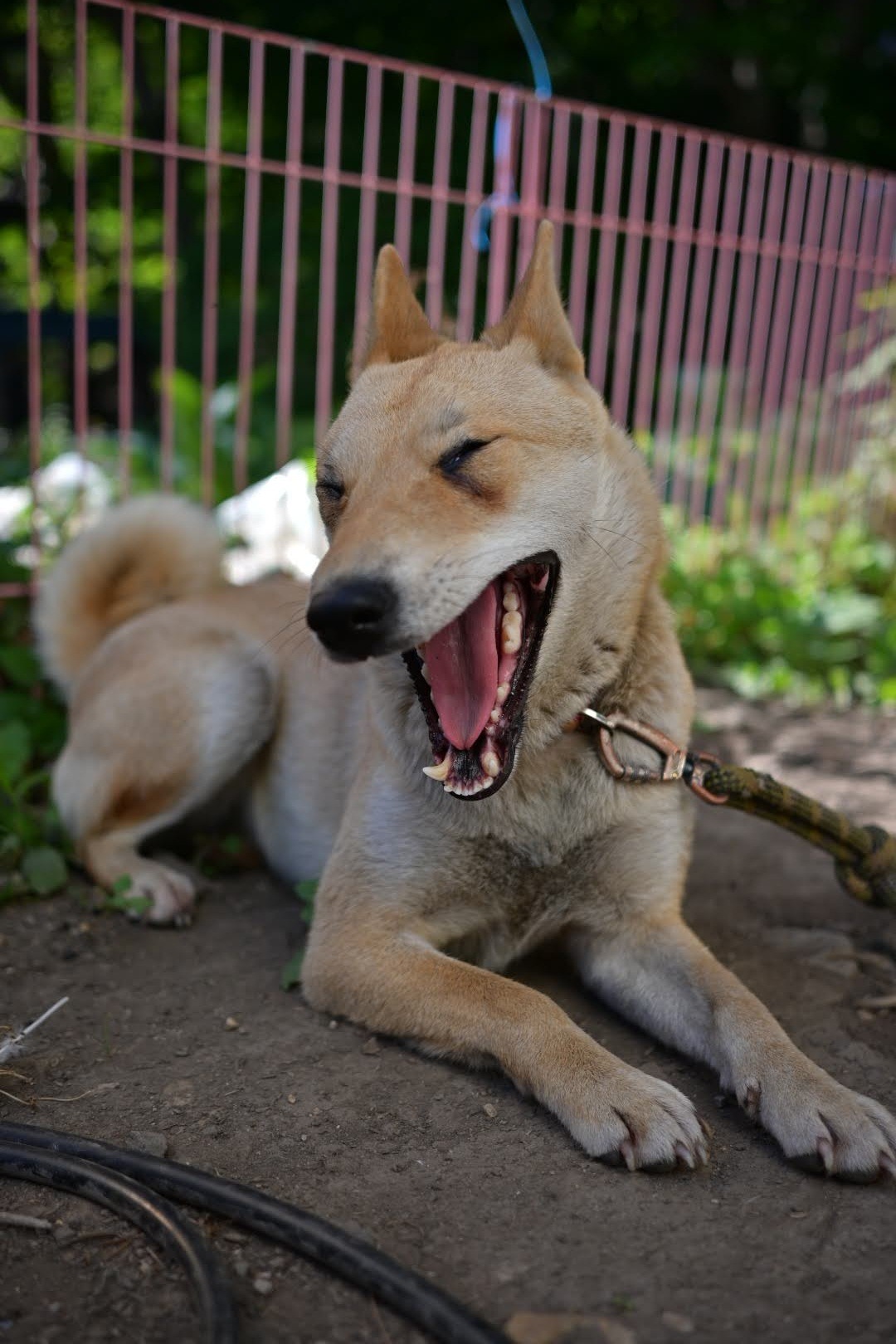
Jomon Shiba conservation standards place high value on having a thick, sturdy jaw with a complete, correctly aligned set of all 42 teeth without missing teeth. When Seta yawns, the thickness of her canines and jaw strength are immediately striking.
Slim Musculature and Pest Protection in Satoyama Environments
Their bodies are lean and muscular with minimal body fat. Due to their agility and alertness, Jomon Shibas have also gained attention for protecting rural farmlands from wildlife.
Official records from the Jomon Shiba Research Center note successful deterrence of black bears, deer, monkeys, and wild boars in chestnut orchards. On my homestead, Seta acts as an invaluable guardian, keeping foxes, mustelids, and rodents away from my roughly 50 free-range chickens.
Raising chickens has taught me that having a dog is almost essential. My area sees plenty of foxes and weasels, and without Seta’s watchful eye, the losses would be far greater. She never harms the chickens and serves as an indispensable partner during mountain foraging and river fishing trips.
Here is a comparison table outlining five key axes to easily distinguish between standard Shibas and Jomon Shibas.
| Comparison Item | Jomon Shiba (Fox Face / Primitive) | Standard Shiba (Tanuki Face / Modern Pet) |
|---|---|---|
| Face & Stop | Shallow stop with a long, straight nasal bridge (fox face). | Deep stop with a rounded, friendly contour (tanuki face). |
| Muzzle & Teeth | Thick, sturdy muzzle with a full set of 42 teeth. | Shorter muzzle with occasional missing teeth from miniaturization. |
| Physique | Lean, athletic musculature with long, light limbs. | Sturdy, rounded, and stocky build. |
| Personality | High alertness, sharp senses, and absolute loyalty to owners. | Generally friendly and suited for standard pet companionship. |
| Acquisition | Specialized breeders or preservation organizations. | Pet shops and commercial pet breeding operations. |
7 Realities of Living with a Jomon Shiba
Living with Seta in Southern Hokkaido (-3°C to -8°C / 18-27°F winters) has revealed many surprising facets. Here are 7 realistic traits I’ve discovered through daily life.
1. Incredible Fuel Efficiency (Low Food Intake + 1-Meal Hybrid Diet)
What surprised me most was how little food Seta needs despite her activity levels. She maintains a healthy, lean physique on just one meal a day.
Her diet combines quality commercial dog food with homestead ingredients: our own free-range eggs, deboned and unsalted cooked meat from roosters, gifted local fish or venison, small amounts of brown rice, and human leftovers strictly devoid of all alliums like green onions and wild garlic.
2. Low Food Intake Yet Boundless Athleticism
Despite eating sparingly, her explosive spring and jumping power are astonishing once she gets moving.
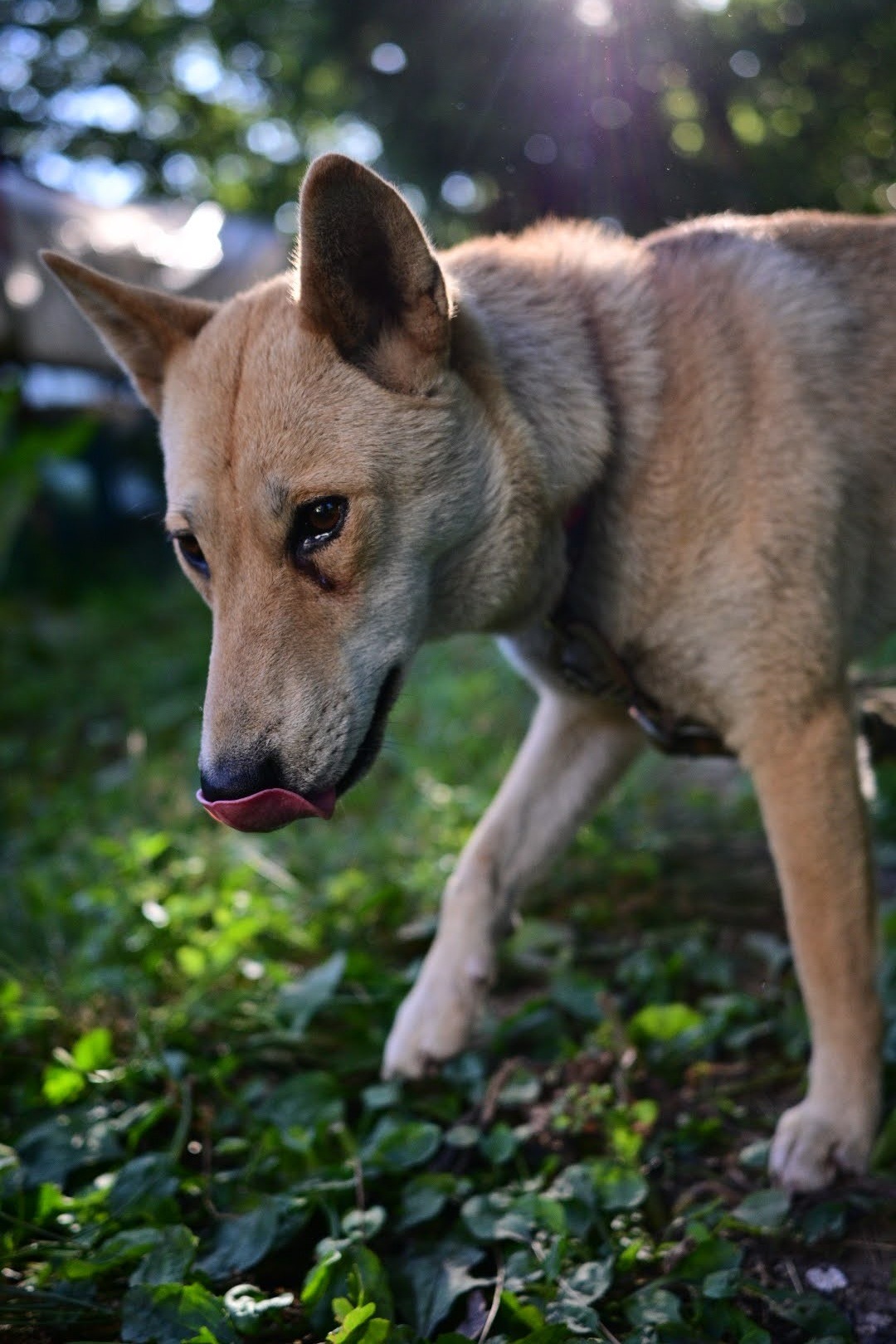
She rests quietly indoors when nothing is happening, but the moment an activity switch flips for a walk, her stamina becomes endless. Because she dives fearlessly into brush and snow, proper gear is essential for outdoor control.
3. Cat-Like Play Habits (A Bundle of Contrasts)
While she acts as a stern guard dog outside, her relaxed play style resembles a cat. When presented with a ball or toy, she uses both front paws dexterously to bat and roll it around by herself.
4. Unwavering, Straightforward Loyalty
She doesn’t wag her tail for everyone, but her trust in her owner is profound. When strangers, foxes, or raccoon dogs approach the property, she immediately alerts me with a warning bark.
5. Surprisingly Quiet Indoors When Outdoor Exercise Needs Are Met
Can Jomon Shibas live indoors? Yes—if their exercise needs are thoroughly met outside, they are remarkably quiet indoors. Confining them in a small indoor space without exercise does not suit their high energy.
We built an aerial dog run (over 250 sqm) behind the house connected via a vinyl curtain on the back door. When outside, she runs with boundless energy; when resting indoors, she curls up in her fleece bed and stays completely silent.
6. Natural Cleanliness Establishing Toilet Habits
Japanese dogs naturally dislike soiling their sleeping quarters. With patient guidance during puppyhood, she quickly learned to eliminate outdoors and in designated spots, never soiling the indoor living space.
7. Escape Tendencies, Homing Instincts, and Wire Accidents
Because of their slim heads and agile frames, escape is a major risk. As mentioned earlier, a vinyl-coated wire rusted from the inside and snapped in under a year, causing Seta to bolt with 1.5 meters of dangling wire.
Finding only her broken collar and wire on the road terrified me. Fortunately, she returned home a few hours later with minor scrapes, saved purely by her homing instinct. That close call prompted me to overhaul my approach to leashes and collars.
4 Essential Gear Items and Safety Practices
Based on lessons learned from my wire accident, here is the exact gear I rely on daily in Southern Hokkaido.
Why I Choose a Collar + Safety Release Instead of a Harness
While harnesses are often recommended for fox-faced Shibas to prevent slipping out, I intentionally use a standard neck collar. This is because a harness allows powerful dogs to lean in with their entire body weight, making control difficult.
A simple collar allows a sharp, gentle tug to immediately command attention when excitement peaks. Furthermore, the 1.5m wire escape incident taught me the importance of a collar-side fail-safe:
- The Danger of Over-Reinforced Collars: If a collar is indestructible and a dog drags a snapped wire that gets snagged on a car or branch, the dog can be dragged or choked.
- The Fact That Only the Collar Came Off: Seta survived because extreme tension caused her collar to release under emergency stress.
- Homestead Safety Balance: The lead rope must be excessively strong and visually inspectable, while the collar should not be indestructible, serving as a life-saving escape hatch.
We now use an aerial dog run where she cannot physically reach public roads, paired with a lightweight 1.5cm-wide nylon collar that provides clear tactile communication.
1. Outings & Walks: 50kg-Rated Nylon Retractable Leash
For mountain walks, I use a wide, heavy-duty nylon tape retractable leash (50kg capacity, 8m/10m model). Unlike metal wire, it won’t rust unseen inside a plastic coating, and any fraying is immediately visible.
2. Home Tethering: UIAA Climbing Rope + Locking Carabiner
For yard tethering, I completely abandoned commercial wire in favor of a UIAA-certified dynamic climbing rope (8.5mm – 10mm diameter, ~7m). Designed to absorb human fall impacts, it offers high strength and slight elasticity to cushion sudden tugs.
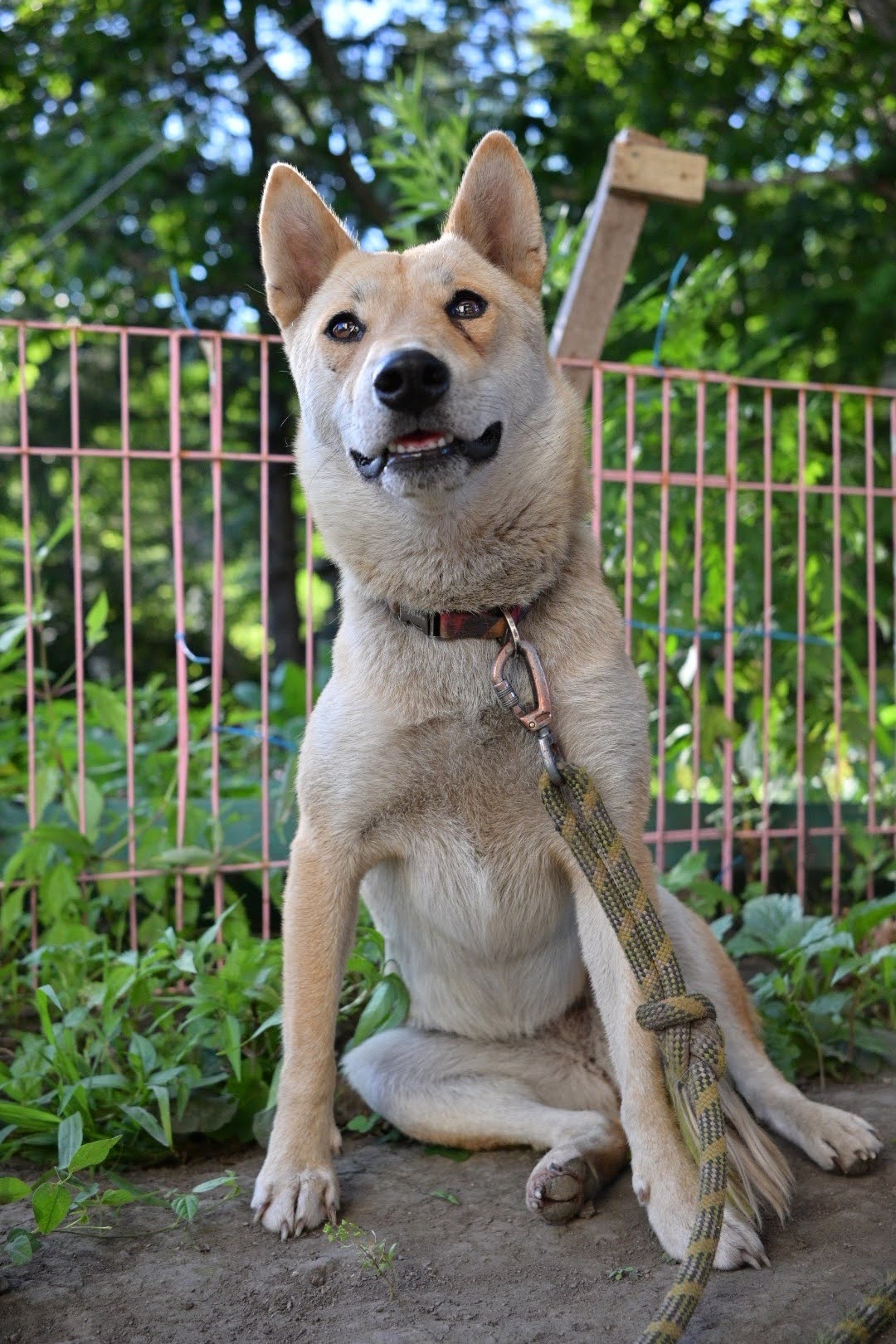
For the connection to the 2.5m high overhead base line, I use a mountaineering screw-lock carabiner (20kN+ rating). Standard hardware can freeze or fatigue in sub-zero winters, but screw-locks never fail.
Disclosure: As an Amazon Associate I earn from qualifying purchases at no extra cost to you.
- UIAA/CE Dynamic Climbing Rope (8.5mm–10mm Single Rope) — 2,000+ kgf (20kN+) breaking strength, shock-absorbing dynamic core; zero internal rust unlike vinyl-coated wire. Field note: Replaced snapped pet-store steel cable on Seta's 20m aerial zip-line dog run. Check US specs on Amazon.com (paid link)
Disclosure: As an Amazon Associate I earn from qualifying purchases at no extra cost to you.
- UIAA/CE Screw-Lock Climbing Carabiner (20kN+ Rated) — Hot-forged aluminum/steel locking carabiner rated >20kN major axis; prevents twist-off escapes. Field note: Connects the 2.5m overhead ridgeline to the 7m drop lead without jamming. Check US specs on Amazon.com (paid link)
3. Grassland & Satoyama Tick Removal: O’TOM Tick Twister
Walking Hokkaido’s grasslands in summer and autumn brings ticks. Pulling them out with bare fingers or tweezers risks leaving mouthparts behind.
We keep the O’TOM Tick Twister (set of 2 sizes) on hand, sliding it under the tick and twisting to remove it cleanly without squeezing the body. It works for both humans and dogs.
Frequently Asked Questions
Q: Are all fox-faced Shibas considered ‘Jomon Shibas’?
A: No, appearance alone cannot confirm it. Jomon Shibas refer specifically to lineages preserved through official organizations like the JSRC, maintaining primitive traits such as shallow stops, thick muzzles, and 42 sound teeth.
Q: Can Jomon Shibas live in apartments or strictly indoor environments?
A: They can stay quiet indoors if outdoor exercise needs are fully met, but their high energy and watchfulness require dedicated time and sound insulation considerations for neighbors.
Q: Between collars and harnesses, which is better for preventing escapes?
A: While harnesses suit city walks for some dogs, powerful Jomon Shibas are harder to control with them. I use a collar for tactile guidance while eliminating wire failure risks using UIAA ropes and heavy-duty nylon leads.
Q: Is commercial dog food enough for a light-eating Jomon Shiba?
A: High-quality commercial food is sufficient, but I supplement Seta’s single daily meal with homestead ingredients like free-range eggs, deboned meats, and local venison.
Conclusion: Understanding Their Wild Nature Makes Them the Ultimate Homestead Companion
Jomon Shibas are an ancient Japanese lineage featuring fox faces, lean musculature, and 42 teeth. Despite low food intake and high athleticism, they act as reliable watchdogs outside and playful, quiet companions indoors.
By ensuring leashes are unbreakable and visually inspectable while using collars for manageable control, you can safely enjoy a long life with this exceptional breed.
[Homestead Tip: Jomon Shiba Safety & Daily Traits]
If these raw Southern Hokkaido field logs are useful for your own off-grid homestead, you can also support Seta & the flock on Buy Me a Coffee.




Comments