
Disclosure: This article contains affiliate links.
I am Kecchi, running an off-grid homestead in the mountains of Southern Hokkaido, featuring small-scale pastured poultry farming (about 50 birds), natural farming plots, and solar power generation.
When starting natural farming or no-till cultivation, many people hit a wall: "Won’t the soil get hard without a tractor?" or "Won’t laying cut grass attract slugs and plant diseases?" Through plenty of trial and error since clearing my land, the conclusion I reached in this cold region was remarkably simple.
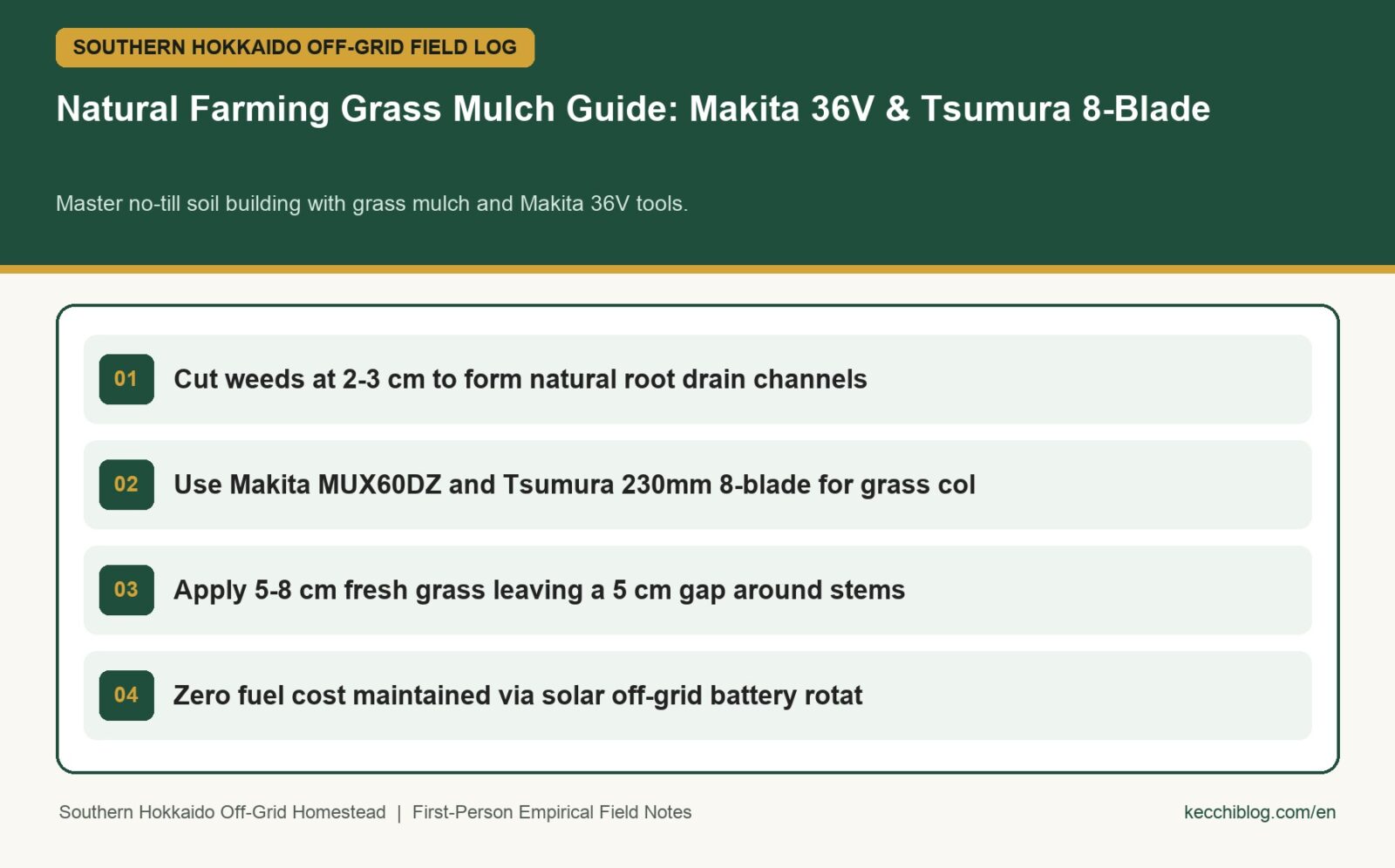
- Cut weeds 2-3 cm above ground instead of pulling them: Roots left in the soil decompose into countless root channels, providing natural drainage and aeration without tilling.
- The main tool for gathering grass is the Makita 36V Split Grass Trimmer (MUX60DZ) paired with a Tsumura Blue Cutter 8-Blade (230mm): Because gathering grass creates heavy loads, a small-diameter 230mm fully hardened 8-blade prevents overload while neatly sweeping grass to the left.
- Apply a 5-8 cm layer of fresh grass in a donut shape, leaving a 5 cm radius around stems: Keeping fresh grass away from stems prevents soft rot and concentrated slug damage.
 けっち
Seta
I rotate about 14 surviving compatible batteries (out of 23 I wore out in the past) charged via sunny-day solar power and a three-unit dual-charger setup, keeping my grass mulch operation running at zero fuel cost.
1. Why Does No-Till Soil Become Fluffy? The Science of Root Channels and Grass Mulch
If you forcefully pull weeds up by the roots, the capillary structure of the soil is destroyed, and dormant weed seeds underneath are exposed to light to germinate all at once. Furthermore, bare soil beaten by direct sunlight and rain forms a hardpan crust on the surface.

On the other hand, if you cut weeds 2-3 cm above the ground without pulling them and spread the grass 5-8 cm thick over the surface (grass mulch), the following natural cycle begins to function in the soil.
| Factor | Bare Ground (Weed Pulling / No Mulch) | Grass Mulch Plot (No-Till) | Field Benefits |
|---|---|---|---|
| Soil Aeration & Drainage | Particles pack down and harden from rain | Decomposed root remnants act as natural drainage and aeration tubes | Crop roots sink deep without heavy machinery |
| Microbes & Aggregates | Surface fungi decrease due to UV and dryness | White-rot fungi and earthworms form granular soil | Rich, dark humus grows without purchasing fertilizers |
| Summer Moisture & Temp | Dries in half a day with high temperature stress | Significantly suppresses evaporation and mitigates temperature spikes | Watering is practically unnecessary even in midsummer relying only on rain and morning dew |
2. Why Use the Makita 36V Split Grass Trimmer (MUX60DZ) with a 230mm Blue Cutter?
Generally, engine-powered grass trimmers in the 26cc class that run continuously on fuel refills suit people who want to mow down vast abandoned fields from morning till night. However, in my field, I rely on the Makita 36V (18V x 2) Cordless Split Grass Trimmer (MUX60DZ) because it eliminates the hassle of mixing gasoline and carburetor clogs, and it won’t startle my pastured poultry even in the early morning.
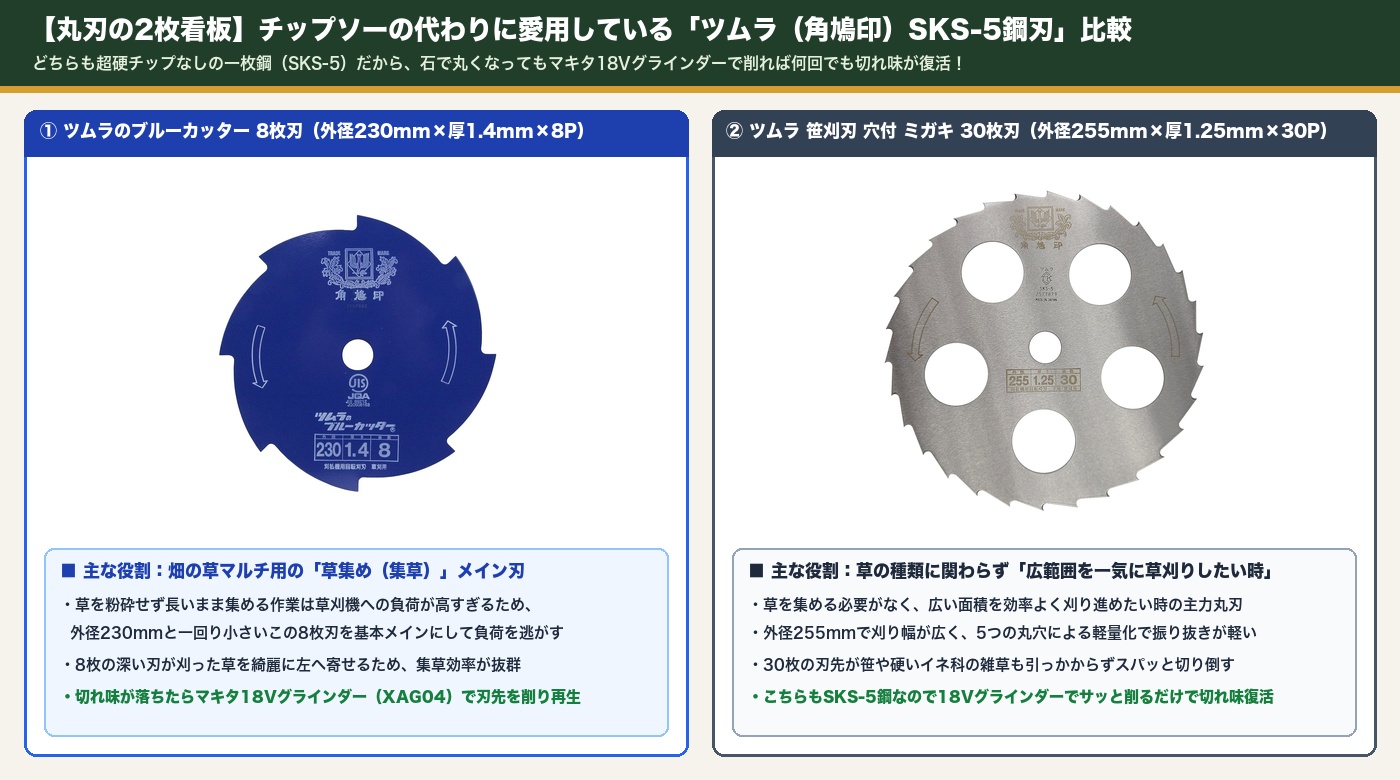
1. Why Choose the Small-Diameter 230mm "Blue Cutter 8-Blade" Instead of Carbide Saw Blades
Standard carbide saw blades from home centers will lose their tips instantly if you graze stony garden soil. Furthermore, the task of mowing down tall grass, catching it on the blade, and sweeping it to the left for mulch placement puts an extreme load on the trimmer.
That is why I purposely use the slightly smaller "Tsumura Blue Cutter 8-Blade (230 x 1.4 x 8P)" rather than the 255mm size as my primary tool for grass gathering. The 230mm small diameter prevents overload stops while its eight flared blades neatly line up the cut grass in a strip to the left, making subsequent gathering dramatically easier. When the blade edges dull, a quick pass with a Makita 18V 100mm disc grinder restores like-new sharpness.
2. For Post Edges and Under Electric Fences: DIATOP Auto-Feed Nylon + Square 2.4mm
Near support posts, under electric fence wires, and in stony areas, I use the "DIATOP Auto-Feed Nylon Cutter (AF5)" combined with "Safety 3 Titanium Square Cord 2.4mm" for pulverized mowing. If the cord extends too much during work, air resistance causes overload, so the iron rule in the field to protect equipment is to manually rotate the cutter head to wind back short lengths whenever it extends too far.
3. Iron Rules for Mulching to Prevent Pests: Pre-Heading Mowing and 5cm Radius Donut Placement
The best timing to cut grass is just before weeds head out and produce seeds (pre-heading). Mowing after seeds mature sows weed seeds all over the field, whereas pre-heading timing offers the best nutritional balance in the plant and the weakest regrowth capacity.
If you press freshly cut grass tightly against crop stems, fermentation heat and excess moisture cause stem rot, leading to soft rot disease or creating a breeding ground for slugs and sowbugs.
Always ensure that a 5cm radius (10cm diameter) of soil around the crop stem is left exposed for airflow, laying the fresh grass 5-8 cm thick in a donut shape around that perimeter. Additionally, tossing some cut grass into the poultry coop as green feed and returning the fully fermented rice hull bedding from the coop floor back under the lower layer of the grass mulch in autumn completes a circular system requiring zero external fertilizer purchases.
Frequently Asked Questions (FAQ)
Q: Doesn’t grass mulch increase slugs and sowbugs?
A: Pests gather if fresh grass is pressed directly against stems, but by strictly implementing the "5cm radius donut placement" to ensure airflow near ground level, feeding damage is greatly suppressed. Over time, natural predators like spiders and ground beetles also settle under the grass mulch to balance the ecosystem.
Q: Is it okay to cut horsetails and houttuynia for grass mulch?
A: Above-ground parts (leaves and stems) cut near ground level can be used safely as mineral-rich grass mulch material. Digging up underground rhizomes and laying them with soil causes them to regrow, so the key is to cut and lay only the above-ground parts without digging.
Q: How do you manage cordless grass trimmer batteries?
A: In my operation, I rotate about 14 active compatible 18V batteries (survivors after wearing out 23 previously), shared with chainsaws and grinders, charged via sunny-day off-grid solar power and a 3-unit dual charger setup (1 genuine DC18RD + 2 compatible duals) to run everything at zero fuel cost.
[Today’s Self-Sufficiency Know-How: Grass Mulch Conclusion for No-Till Soil]
– Cut weeds before heading at 2-3 cm height to foster root drainage channels and fungal-earthworm aggregate structures.
– For heavy-load grass collection, use the Makita 36V Split Grass Trimmer (MUX60DZ) with a Tsumura 230mm Blue Cutter 8-blade, resharpened using an 18V grinder.
– Apply 5-8 cm thick fresh grass while keeping a 5 cm stem radius clear in a donut shape to prevent rot and pests.
You don’t need to buy dedicated potting mixes or fertilizers for every vegetable every year; plant physiology and simple general-purpose materials are more than enough. I condensed a 5-major reverse-lookup practical table and list sheet (58-row TSV/PDF bonus) into a single note you can check on your smartphone in 3 seconds right from your garden or balcony.
- Edo Material to Modern "Odorless, General-Purpose 6 Materials" Conversion Table (such as oyster shell organic lime eliminating slaked lime’s 2-week wait)
- Smartphone Reverse-Lookup Dictionary for 24 Major Vegetables (basal fertilizer needs, spacing, crop rotation history, companion planting + cold-climate perennials & 3-year family rotation puzzle)
- Pesticide-free pest control manual & zero-electricity winter storage guide (printable data sheet bonus included)
Here is a summary of the grass trimmers, steel blades, nylon cutters, and selection tips (Makita reviews) actually used in this article. You can compare current prices and stock across online shops.
- Makita 36V Cordless Split Grass Trimmer (MUX60DZ) & 18V 100mm Disc Grinder: Split design for easy car transport, compatible with cultivations attachments, paired with a grinder that sharpens steel blades in seconds. See US Gear Box below.
- Tsumura Blue Cutter 8-Blade (230 x 1.4 x 8P): SKS-5 fully hardened steel blade resistant to overloading during heavy grass gathering while sweeping cuttings neatly left. See US Gear Box below.
- DIATOP Auto-Feed Nylon AF5 + Safety 3 Titanium Square 2.4mm: Pulverizing cutter for post edges and fence lines (Note: wind back cord manually if it extends too far). See US Gear Box below.
If these raw Southern Hokkaido field logs are useful for your own off-grid homestead, you can also support Seta & the flock on Buy Me a Coffee.





Comments