*This article contains promotional affiliate links. Based on my first-hand reading and verification on my homestead in Southern Hokkaido, I record both the merits and drawbacks honestly.
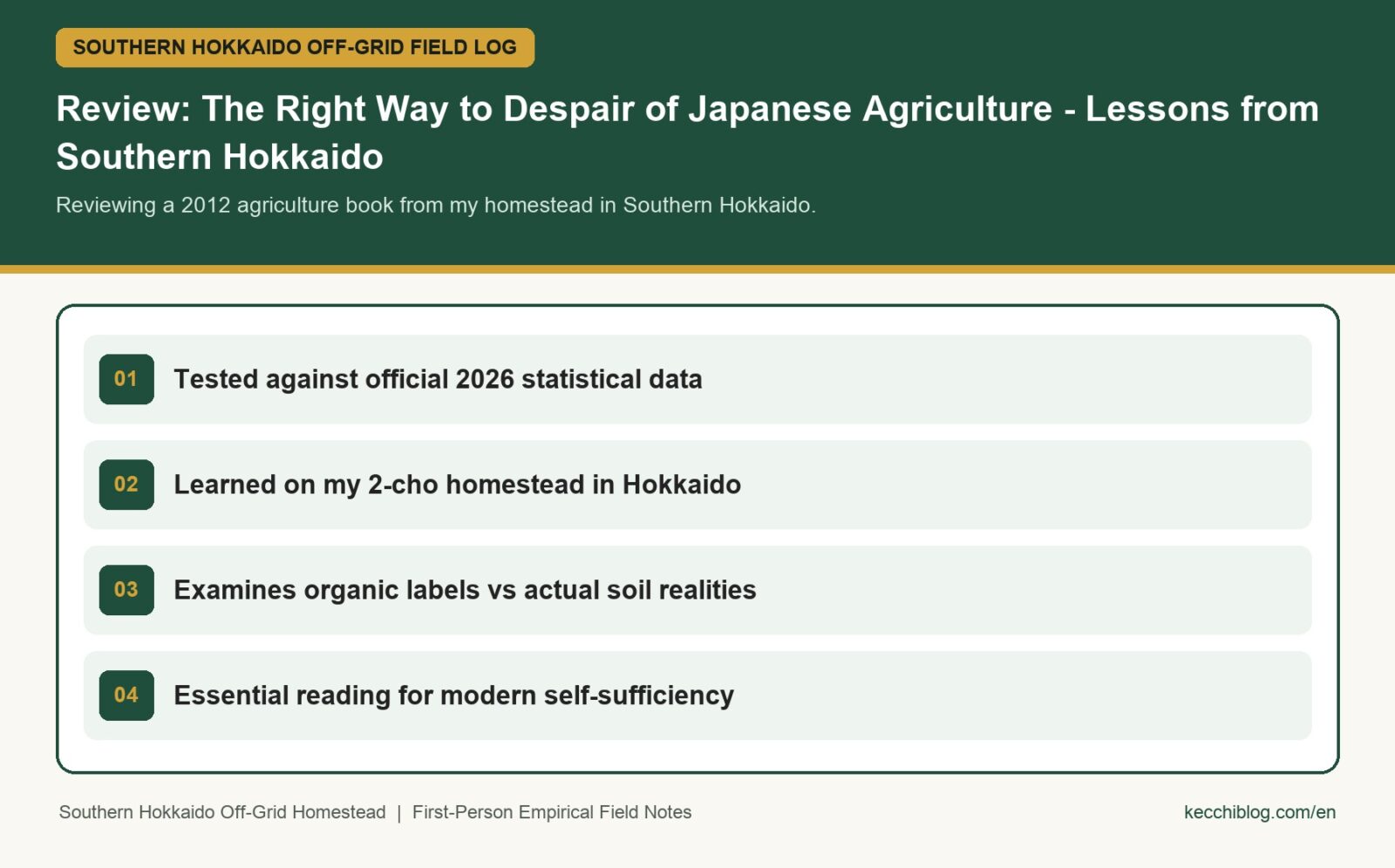
After moving to Southern Hokkaido to pursue natural farming and self-sufficiency, I read the 2012 paperback “The Right Way to Despair of Japanese Agriculture” by Yoshihisa Kamado (Shinchosha Shinsho).
While this book offers a harsh critique of the organic cultivation and natural farming booms, reading it after actually touching the soil made me realize it is not really a farming book at all, but rather a profound analysis of modern societal structures.
Usually, beginners starting a home garden or rural life dive straight into practical cultivation how-to guides. However, understanding the underlying structure of why safety-and-security trends and subsidy-dependent agriculture often fail saved me from countless detours.
Today, I am comparing the book’s 14-year-old warnings against 2025-2026 official statistics while sharing what living with vegetables and chickens on my 2-cho plot in Southern Hokkaido has taught me about the difference between “abandonment and order” and the true taste of homegrown food.
These books go beyond simple cultivation manuals to help you grasp the social structures behind food and agriculture, establishing your own benchmarks tested by your hands and palate.
Use the links on the right to jump directly to each review section below.
| Book Title & Author | Features & Highlights from the Field | Price & Comparison |
|---|---|---|
| “The Right Way to Despair of Japanese Agriculture” by Yoshihisa Kamado | A pioneering book exposing the illusions of organic farming, over-standardization, and superficial consumption 14 years ago | See US Gear Box below |
| “Reconstructing Japanese Agriculture: A Sad Utopia” by Yoshihisa Kamado | A sequel expanding the author’s analysis to Reiwa-era farming, forestry, and fisheries | See US Gear Box below |
| “Destroying Vegetables” by Katsuyuki Niinome | A report cited in Chapter 1 tracking nutritional decline and soil degradation | See US Gear Box below |
| “Natural Egg Poultry Farming (Enlarged Edition)” by Tadashi Nakajima | The practical bible I used as the foundation for my free-range poultry and self-sufficient nutrient cycle | See US Gear Box below |
- Not for you (if you want practical guides): If you are looking for step-by-step instructions on pinching tomato side shoots or quick home gardening hacks, standard cultivation encyclopedias will serve you much better.
- A must-read right now: Essential for anyone wanting to see behind comforting buzzwords like “organic, pesticide-free, and local production for local consumption,” or those questioning the rigidity of modern society and declining food quality.
- Handling 14-year-old data: Published in 2012 right after the earthquake and during the DPJ administration, the raw statistical figures are dated, but the structural insights feel even more accurate today in 2026.
 けっち
balloonName: Seta If you only look at the title, it sounds like an academic text for agricultural professionals, but the core is actually an anatomy of humanity and society, asking why craftsmen who could read the weather just by looking at the sky disappeared, replaced by people who only trust labels and marketing pitches.
1. Did the 2012 Predictions Come True? Checking Against Latest 2026 Statistics
To put it bluntly, the book’s warnings 14 years ago regarding the sharp decline in successors, the non-farmer majority in agricultural cooperatives (JA), and the hollowing out of farmland registries have largely materialized in official 2026 statistics.
Meanwhile, rice prices deviated from the prediction of unilateral decline due to oversupply, erupting instead into an even more troublesome pattern of extreme volatility.
| Comparison Item | 2012 Book Descriptions & Predictions | 2025–2026 Latest Official Statistics | Field Perspective Evaluation |
|---|---|---|---|
| Farmers & Management Entities | 2.53 million farming households (as of 2010) | 836,000 agricultural management entities (down 22.3% in 5 years; MAFF FY2025 White Paper) | Abandonment and corporate consolidation accelerating rapidly |
| Aging & Active Workforce | Roughly two-thirds of workers aged 65 and older | 1.036 million core agricultural workers, average age 67.7 (MAFF FY2025 White Paper) | Active workforce on the verge of falling below 1 million |
| Farmland Abandonment & Registration | Warned of idle land awaiting conversion and registry defects | Cultivated land 4.21 million ha (Published Oct 2026), abandoned farmland 257,000 ha, unregistered inherited land 520,000 ha (FY2024 White Paper) | Unidentified owner issues becoming prominent |
| JA Member Composition | 4.07 million regular, 4.06 million associate (distortion of non-farm integration) | 3.85 million regular, 6.36 million associate members (JA Fact Book 2026) | Associate members reversed to roughly 1.65x |
| Rice Prices & Food Self-Sufficiency | Rice price drops from production adjustment collapse; empty debates on self-sufficiency | Self-sufficiency rate 37% (FY2024). Rice prices dropped from 35,056 yen in Feb 2026 to 21,434 yen per 60kg in Oct (down 42% YoY) | Wild price fluctuations amid soaring material costs |
Helping neighboring farmers with their work here in Southern Hokkaido allowed me to feel the hardship hidden behind these numbers firsthand.
Because a single tractor or combine costs as much as or more than a car (ranging from several million to over 10 million yen), and specialized machinery used for only one week a year during sowing or harvesting must be maintained and repaired for 20 to 40 years, maintenance costs, pesticides, chemical fertilizers, and annual seed costs continually eat away at profits.
On top of that, shipping prices cannot be set independently, leading to drastic drops like the 42% year-on-year plunge in relative transaction prices during the autumn 2026 new rice season.
The reality that “operations would collapse instantly without government subsidies” matches the analysis in Chapters 3 and 6 of the book—warning that mechanization and standardization cannot survive without subsidies—without a single millimeter of error.
2. Why Did Weather-Reading Craftsmen Disappear? The Boundary Between “Abandonment” and “Order”
What struck me most while reading the book were the stories of two rice-farming masters introduced in Chapter 1.
They could forecast the weather months in advance simply by observing how insects flew, weeds grew, or the wind blew, and could tell past management histories just by touching the rice leaves in another farmer’s paddy. Tragically, these skills died with them because they had no one to pass them on to.
Pondering why such people no longer grow up, I realized that school education and screen-centric lifestyles have outsourced all experiences of “guessing based on one’s own senses and failing” to external manuals and machines.
In the book, the author compares this to the difference between supermarket pre-packaged sushi (standardized manual techniques operable by anyone) and authentic sushi chef craftsmanship (adapting daily to shifting natural conditions).
- The misconception that “organic cultivation equals absolute goodness”: The book cuts into practices where immature livestock waste is superficially processed into “fake compost” and dumped in massive quantities, placing soils into a nitrogen-overloaded metabolic state that degrades both flavor and groundwater.
- A cold splash of water on natural farming and laissez-faire booms: Conversely, it severely criticizes zero-pesticide, zero-fertilizer “extensive agriculture” as nothing more than an escapist fantasy for urbanites.
- Lessons learned from my own reclamation work on “abandonment” vs. “order”: When I first cleared trees and tried simply cutting weeds before sowing seeds, or digging holes and leaving pumpkin seedlings completely unattended, tree root nitrogen starvation and weeds caused total failure.
Moving here because I wanted to do natural farming, I appreciated the book’s critiques because I learned on the ground that “doing nothing/abandonment (disorder)” and “frameworks allowing nature to run itself (order)” are entirely different things.
For instance, free-range chickens left in the open without predator defenses will be attacked by foxes and crows. Likewise, gardens need our homemade perimeter electric fences insulated with water hoses to deter Ezo sika deer, along with proper initial conditions for soil temperature and drainage. Only when humans set up this “outer framework of order” can plants and 50 free-range chickens thrive vigorously following their instincts.
3. Consumers Who Eat Marketing Instead of Flavor: What Cooking My Carrots in a Pot Taught Me
Another sharp piercing point in the book is the degradation of consumers’ palates (downstream issues).
Failing to judge flavor quality with their own tongues, consumers reassure themselves with labels like “organic cultivation,” “farmer profile photos,” and “local production for local consumption.” The author compares this to an insecure marriage where people check around for favorable conditions without experiencing true happiness.
This critique becomes vividly apparent when comparing your own homegrown vegetables to supermarket produce.
Call it grower’s bias if you like, but vegetables grown wildly without relying on overprotective fertilizers or pesticides exhibit a remarkably stronger “individual character” than uniform supermarket produce.
- Differences in carrot aroma and sweetness: The most noticeable difference is in carrots left to overwinter in our unheated hoop house for seed saving, offering an aroma and richness completely distinct from commercial carrots bred to eliminate off-flavors.
- Firmness in cabbage and daikon radishes: Cabbage grown through harsh temperature swings is sweet down to its core, and daikon radishes have dense fibers that hold flavor in any cooking method.
- Simple “hot pots” leave no room for deception compared to stir-fries: While I don’t go as far as the author’s suggestion to “savor every meal like a date,” my dinner is almost every day a simple hot pot of sliced vegetables and fish boiled in water.
As the book mentions (Chapter 1), traditional Japanese cuisine didn’t involve stir-frying in vegetable oil, and pouring dressing (oil) over raw vegetables is a post-war custom.
A “plain hot pot” without oil or heavy sauce coatings takes just 5 minutes to prep and clean, and immediately reveals whether the vegetables themselves grew in a healthy environment.
balloonName: Seta It’s not that supermarket vegetables are bad, but I realized that “bland, standardized items that won’t draw complaints from anyone” and “wild, rich-flavored crops produced when environmental conditions align perfectly” belong to entirely different categories.
4. Related Reading Guide: Books to Read Alongside “The Right Way to Despair of Japanese Agriculture”
Here are four books for those wanting to dive deeper into the realistic structures of food and agriculture or low-cost self-sufficient cycles.
Starting with the accessible paperback “The Right Way to Despair of Japanese Agriculture” is the safest bet.
Published in 2012, this masterpiece covers the flip side of organic booms, JA and subsidy structures, and the drawbacks of manual-dependent thinking (see Shinchosha Official Page).
Even for those outside agriculture, it is worth keeping on hand as a guide on how to evaluate modern information.
Published in 2022, 10 years after the first book, this is an advanced sequel crossing Reiwa-era agriculture, forestry, and fisheries (see Minerva Shobo Official Page).
It delves deeper into why failing to listen to the voices of crops and livestock in the field proves harmful.
Cited in Chapter 1 (p. 19) of “The Right Way to Despair of Japanese Agriculture” as evidence for nutritional declines like halved vitamin C levels in vegetables (see Shueisha Shinsho Official Page).
A supplemental read for understanding how chemical fertilizer bias and poor soil management altered the contents of vegetables.
Additionally, for those wanting to learn concrete methods to cycle life and food on a small scale within your own land without relying on heavy machinery or commercial feed, I recommend the classic book by Tadashi Nakajima, which inspired me to start raising 50 free-range chickens.
Disclosure: As an Amazon Associate I earn from qualifying purchases at no extra cost to you.
- Natural Pastured Poultry Reference (Tadashi Nakajima Method) — foundational Japanese natural-egg poultry text; inspired my deep-litter & unheated air-flow coop philosophy. Field note: Original Japanese book is Japan-only; US equivalent natural-flock reference linked. Check US specs on Amazon.com (paid link)
Frequently Asked Questions (FAQ)
Q: Published back in 2012, is the content outdated for readers in 2026?
While the historical context such as statistical figures and post-quake descriptions date back to 2012, foundational structures like “skill loss through standardization,” “consumer psychology buying peace of mind through labels and marketing,” and “distortions in subsidies and land conversion” remain relevant.
In fact, reading it today in 2026 amid AI/social media prevalence, soaring material costs, and rice price volatility feels even more pressing.
Q: Is this book interesting for office workers who do not farm or garden?
Yes. Instead of a cultivation manual, it reads as a social critique exploring “why school education and corporate manual-thinking strip fields of their power” and “why people get swept up in pleasant-sounding trends,” making it fully enjoyable with zero farming experience.
Q: Does reading this lead to the conclusion that all organic and natural farming is bad?
The author criticizes “the trend of accepting organic and pesticide-free labels at face value without underlying skills or soil preparation.”
On my homestead, unmanaged neglect fails entirely, whereas vegetables whose environmental and soil conditions align properly gain exceptional aroma and sweetness, making the greatest lesson “verifying things with physical reality and your own palate rather than labels.”
Conclusion: I Don’t Recommend Self-Sufficiency for Everyone, But Having a Personal Testing Standard Is Useful
Honestly, I do not recommend that everyone pack up and move to the countryside for self-sufficiency.
Modern convenient supermarkets and distribution systems support many people’s lives, and there is no need for everyone to force themselves to farm.
However, in an era where it is hard to see what is true and what is false, maintaining a perspective of testing things with your own hands and palate on a small scale instead of blindly trusting television or packaging slogans completely changes how you view daily life.
It is a slightly cynical paperback from 14 years ago, but if you have ever felt a sense of discomfort with conventional platitudes, give its pages a flip.
[Today’s Self-Sufficiency Know-How: Field Perspectives from “The Right Way to Despair of Japanese Agriculture”]
– Structural warnings from 14 years ago (accelerating departures, non-farmer JA, unregistered land) largely accurate in 2026 stats
– Clearly distinguish between “doing nothing/abandonment” and “order created by setting up external environmental frameworks and letting nature work”
– Verify material individuality using simple hot pots and your palate rather than organic labels and marketing
- “The Right Way to Despair of Japanese Agriculture” by Yoshihisa Kamado: Return to 3-shop comparison box ↑
- “Reconstructing Japanese Agriculture: A Sad Utopia” by Yoshihisa Kamado: Return to 3-shop comparison box ↑
- “Destroying Vegetables” by Katsuyuki Niinome: Return to 3-shop comparison box ↑
- “Natural Egg Poultry Farming (Enlarged Edition)” by Tadashi Nakajima: Return to 3-shop comparison box ↑
A list of tools and materials I actually use continuously in my self-sufficient life in Southern Hokkaido is compiled in Southern Hokkaido Self-Sufficiency Life Gear & Materials Summary, and the complete data on household finances and equipment running on under 500,000 yen annually without relying on subsidies or specialized products is organized in the Hokkaido Off-Grid Financial White Paper (note).
If these raw Southern Hokkaido field logs are useful for your own off-grid homestead, you can also support Seta & the flock on Buy Me a Coffee.

Comments