Disclosure: As an Amazon Associate I earn from qualifying purchases at no extra cost to you.
Out in the hills of Southern Hokkaido, where winter temperatures sit around -3°C to -8°C (18–27°F) and
snow buries the fence lines, I keep roughly 50 pastured chickens—20 to 30 adult laying hens plus home-hatched pullets and roosters.
Whenever visitors hear about winter poultry in Hokkaido, the same three worries come up:
“Won’t they freeze without coop heaters?” “Aren’t you hauling buckets of warm water all day to smash frozen bowls?” “How do you keep egg numbers high in January?”
After overwintering my flock in a salvaged greenhouse hoop-pipe coop with zero electricity, here is the unfiltered field truth:
chickens are walking down parkas that need 24/7 dry airflow and snow-drift protection—never an airtight sealed coop.
Even when droppings freeze solid on top of the rice-hull litter, the birds stay healthy without a single heater,
hydrate themselves by eating crunchy lower-layer granular snow, and coast sustainably through winter on rationed grain yielding just 2 to 3 home-use eggs a day.
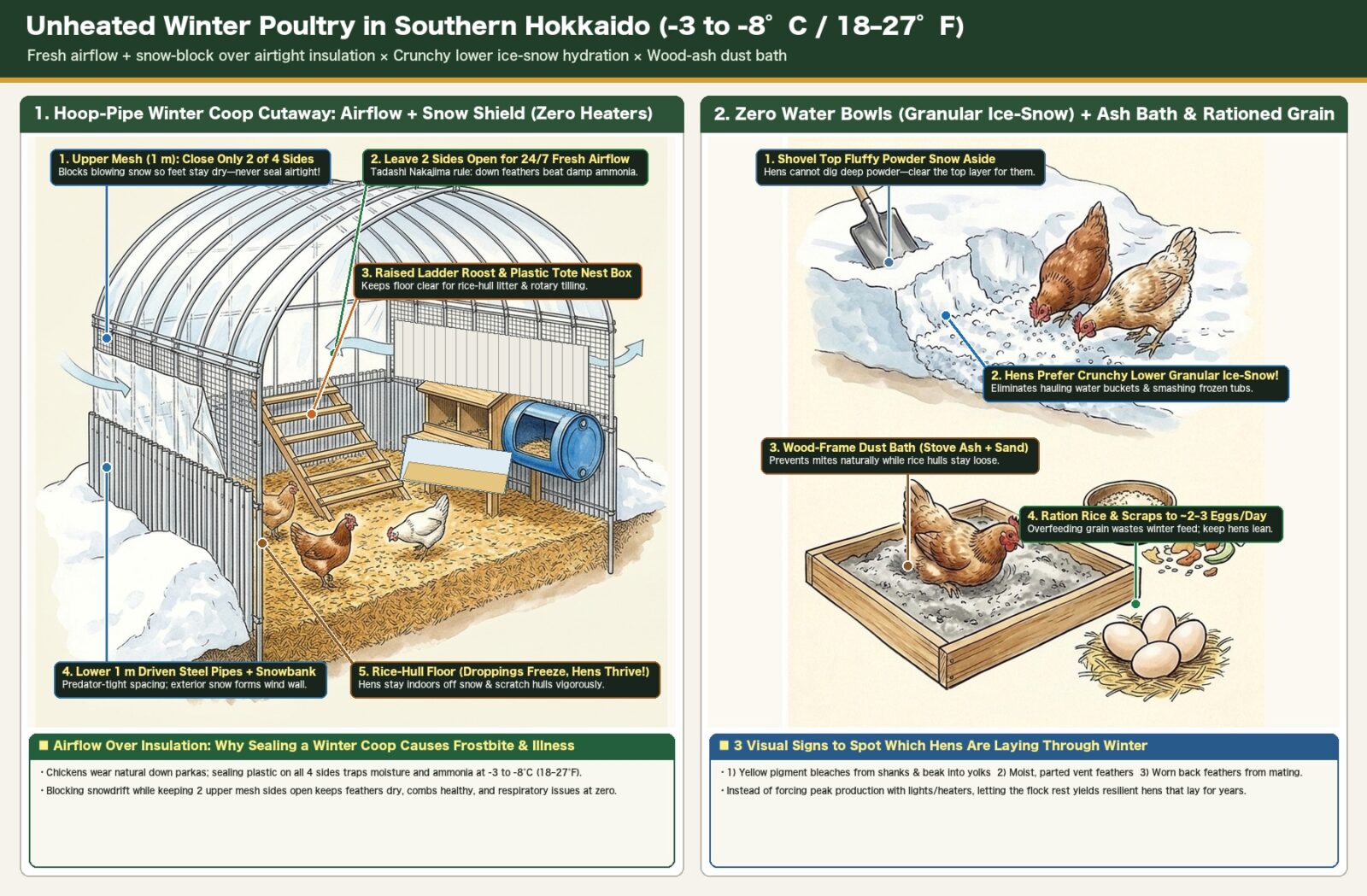
- Airflow + Snow Shield Beats Insulation: Following Tadashi Nakajima’s Natural Poultry Farming principles, sealing a winter coop traps damp breath and ammonia. Closing only 2 of the 4 upper mesh walls blocks blowing snow while keeping 2 sides open for fresh air.
- Zero Water Bowls (Crunchy Granular Ice-Snow): Hens ignored lukewarm water bowls in favor of snow—specifically the coarse, crunchy corn-snow underneath the fluffy top powder. Shoveling the top powder aside solves winter hydration with zero frozen buckets.
- Rationed Winter Grain (2–3 Eggs/Day): Overfeeding rice pushes hens into wasteful heavy winter laying; tuning grain + kitchen scraps to yield just 2–3 eggs/day feeds our cabin while letting the flock rest.
 けっち
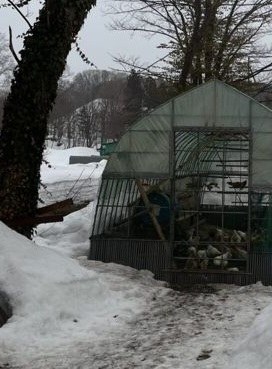
Droppings on the rice-hull floor freeze solid on cold mornings,
yet not a single bird gets sick—as long as blowing snow stays off their feet and fresh dry air keeps moving through the upper mesh.
1. Airflow Over Insulation: Our Two-Tier Salvaged Hoop-Pipe Winter Coop
My bible for flock management is Tadashi Nakajima’s classic Japanese manual Natural Egg Poultry Farming (Shizenran Yokeiho),
which ranks uninterrupted fresh air first among the five pillars of poultry health (air, sunlight, water, bare earth, and green forage).
Wrapping a winter coop airtight in plastic traps moisture from breath and droppings,
spiking humidity and ammonia—the real triggers behind frostbitten combs and respiratory disease.

- Lower Tier (Ground to ~1 m / 3.3 ft): Salvaged steel greenhouse pipes driven straight into the ground at predator-tight spacing. Open on all four sides during warm months, this bottom meter gets naturally banked by exterior snow in winter, cutting ground-level wind chill.
- Upper Mesh Tier (1 m to 2 m / 3.3–6.6 ft): Out of four wire-mesh sides, I cover only two sides—not to trap heat, but strictly as a snow shield so windblown powder doesn’t pile inside and chill the hens’ feet, leaving the other two sides open for 24/7 cross-ventilation.
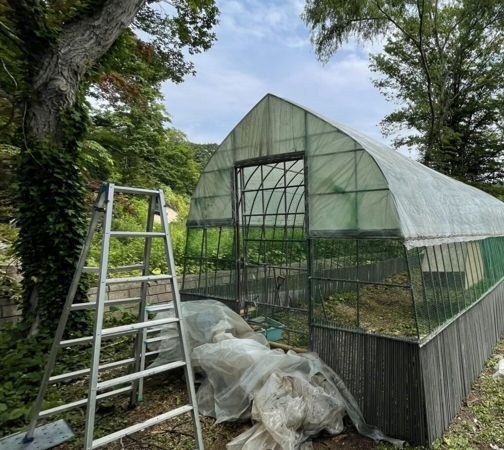
Because adult hens relentlessly peck smaller youngsters, I currently house home-hatched juveniles and extra cockerels here in the stationary house-side coop while
keeping our main laying hens separated out in the pasture coop setup.
2. Honest Deep-Litter Reality: Yes, Droppings Freeze—And Hens Hate Walking on Snow
Homesteading books sometimes paint a rosy picture where fermenting rice-hull deep litter stays steaming warm like radiant floor heating all winter.
Let me give you the honest reality from my coop: in a well-ventilated open-air hoop house at -3°C to -8°C (18–27°F), surface droppings on top of the rice hulls freeze solid.
Even if slow microbial decomposition buffers the sub-layer slightly, fresh air comes first.
Yet because the roof and two shielded walls keep snow off the rice-hull floor, the hens stay dry-footed,
scratch vigorously through the loose hulls all day, and power through winter with zero illness.
Even if I prop the coop door wide open, chickens hate stepping onto cold snow—once the ground turns white, they voluntarily stay indoors until bare soil reappears in spring.
3. Why I Quit Hauling Winter Water: Crunchy Lower-Layer “Corn Snow”
Fighting frozen waterers is usually the #1 winter chore for northern flock keepers.
When I first started hauling bowls of lukewarm water out to the coop, I noticed something funny: the hens walked right past the warm water to peck at snow.
Watch closer and an even clearer preference jumps out.
Chickens don’t like airy, freshly fallen powder snow on top—they go crazy for the coarse, crunchy,
granular ice-snow (“corn snow” / zarame layer) buried near the bottom of the snowpack, whose firm ice crystals match the size of grit and whole grain in their beaks.
Because chickens won’t dig through deep powder themselves, I quit using winter water bowls completely:
every couple of days I scrape the fluffy top snow aside with a shovel to expose fresh crunchy lower ice-snow, and hydration takes 30 seconds.
4. Off-the-Floor Roosts, Movable Tote Nests & Wood-Stove Ash Baths
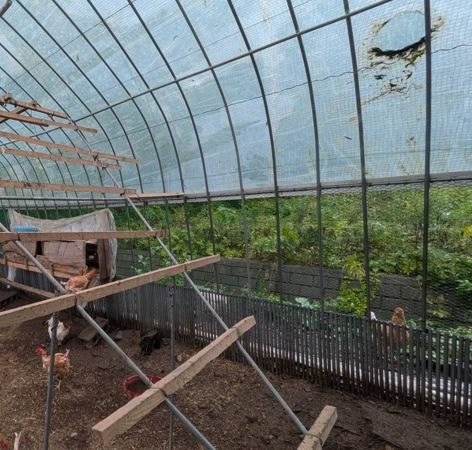
Inside the coop, every modification aims to keep the floor clear for bedding management.
Heavy floor-standing wooden nest boxes get in the way whenever I dump fresh rice hulls or run the Makita rotary cultivator attachment across the litter,
so I tore out the old box in favor of raised wall-mounted structures or lightweight deep polypropylene totes filled with rice hulls that lift out with one hand.
Meanwhile,
clean hardwood ash scooped daily from our cabin wood stove—previously scattered loose on the floor—is getting
a simple four-board wooden frame filled with sand + wood ash as a dedicated winter mite-control dust bath.
5. Deliberately Holding Winter Lay to 2–3 Eggs/Day (+ 3 Signs of an Active Layer)
Commercial operations blast hens with artificial light to force year-round laying, shortening their lifespan and risking egg binding.
My winter goal is the exact opposite: I actively avoid over-producing eggs in winter, simply because
buying extra grain when bugs and pasture grass are buried under snow is wasteful when 2 to 3 eggs a day covers my own meals.
| Season | Feeding Regimen (20–30 Adult Hens) | Daily Egg Yield |
|---|---|---|
| Spring – Summer | Fed once daily; daytime free-range foraging on pasture grass & insects. | ~10+ eggs/day (~1 egg every 2 days per hen) |
| Mid-Winter (-3 to -8°C) | Cull brown rice (carbs for body heat) + kitchen scraps tuned so hens don’t over-lay. | 2–3 eggs/day (exact homestead self-sufficiency target) |
When managing dozens of birds on deep litter without trap-nests, you can still spot which hens are actively laying in winter by checking three biological clues:
- Bleached Shanks & Beak (Xanthophyll Depletion): Yellow carotenoid pigment (xanthophyll) stored in skin, beak, and shanks diverts rapidly into egg yolks during steady laying—so pale, bleached legs signal an active producer.
- Vent Feather Condition: Active layers show parted, slightly moist or worn feathers around a wide, pliable vent compared to tight, dry plumage on resting hens.
- Saddle / Back Feather Wear: Bare or ruffled back feathers show which hens are actively crouching for roosters.
6. Frequently Asked Questions
A. Yes.
Adult feathered chickens carry a 41°C (106°F) core body temperature under dense down insulation.
Keep windblown snow off their feet, give them dry rice hulls and 24/7 ventilation, and expose granular lower-layer snow with a shovel—zero electricity required.
A. Keep roosts and nest structures either suspended/cantilevered along the walls with open space underneath,
or use grab-and-go deep plastic totes so nothing blocks adding hulls or aerating the earth floor in spring.
Field-Tested Gear Used in This Log
Disclosure: As an Amazon Associate I earn from qualifying purchases at no extra cost to you.
- Natural Pastured Poultry Reference (Tadashi Nakajima Method) — foundational Japanese natural-egg poultry text; inspired my deep-litter & unheated air-flow coop philosophy. Field note: Original Japanese book is Japan-only; US equivalent natural-flock reference linked. Check US specs on Amazon.com (paid link)
Disclosure: As an Amazon Associate I earn from qualifying purchases at no extra cost to you.
- Heavy-Duty Lidded Polypropylene Tote / Nest Box Tub — Washable deep-wall utility tote repurposed as draft-free raised nest boxes and rodent-proof grain bins. Field note: Easy to sanitize, light to mount off the coop floor, and impervious to moisture. Check US specs on Amazon.com (paid link)
Disclosure: As an Amazon Associate I earn from qualifying purchases at no extra cost to you.
- Galvanized Greenhouse Hoop Pipes (19mm / 22mm) & Spring Wire Lock Channel — 3/4-inch agricultural steel tubing bent into snow-shedding arches, secured with wiggle-wire lock channel. Field note: Lightweight enough for one-person hand-pulling yet shrugs off coastal wind. Check US specs on Amazon.com (paid link)
If these unheated northern poultry notes help simplify your own winter chores, you can support the flock & Seta on Buy Me a Coffee.




Comments